
TSXV · Environmental services
BQE Water: contracted for the life of the mine
Proprietary mine-water treatment technology: how projects can become long-term operating contracts, and the risks to monitor.
Share price
Since purchase
Price in local currency, excluding dividends. Latest available quote; may be delayed.
The thesis in three points
- Opportunity
- Water-treatment technology with the potential to convert projects into operating contracts.
- Key assumption
- Projects convert into recurring revenue and technical expertise retains its value to customers.
- What to monitor
- Pipeline conversion, operating margin, collections and concentration by customer and site.
Valuation and prices refer to the original analysis date. Subsequent updates are identified separately.
In this analysis
Published July 2026. Market cap at publication ~C$90m; ~1.30m shares; net cash ~C$19m. Reasoning in enterprise value and owner’s earnings — no EBITDA.
The one-paragraph version
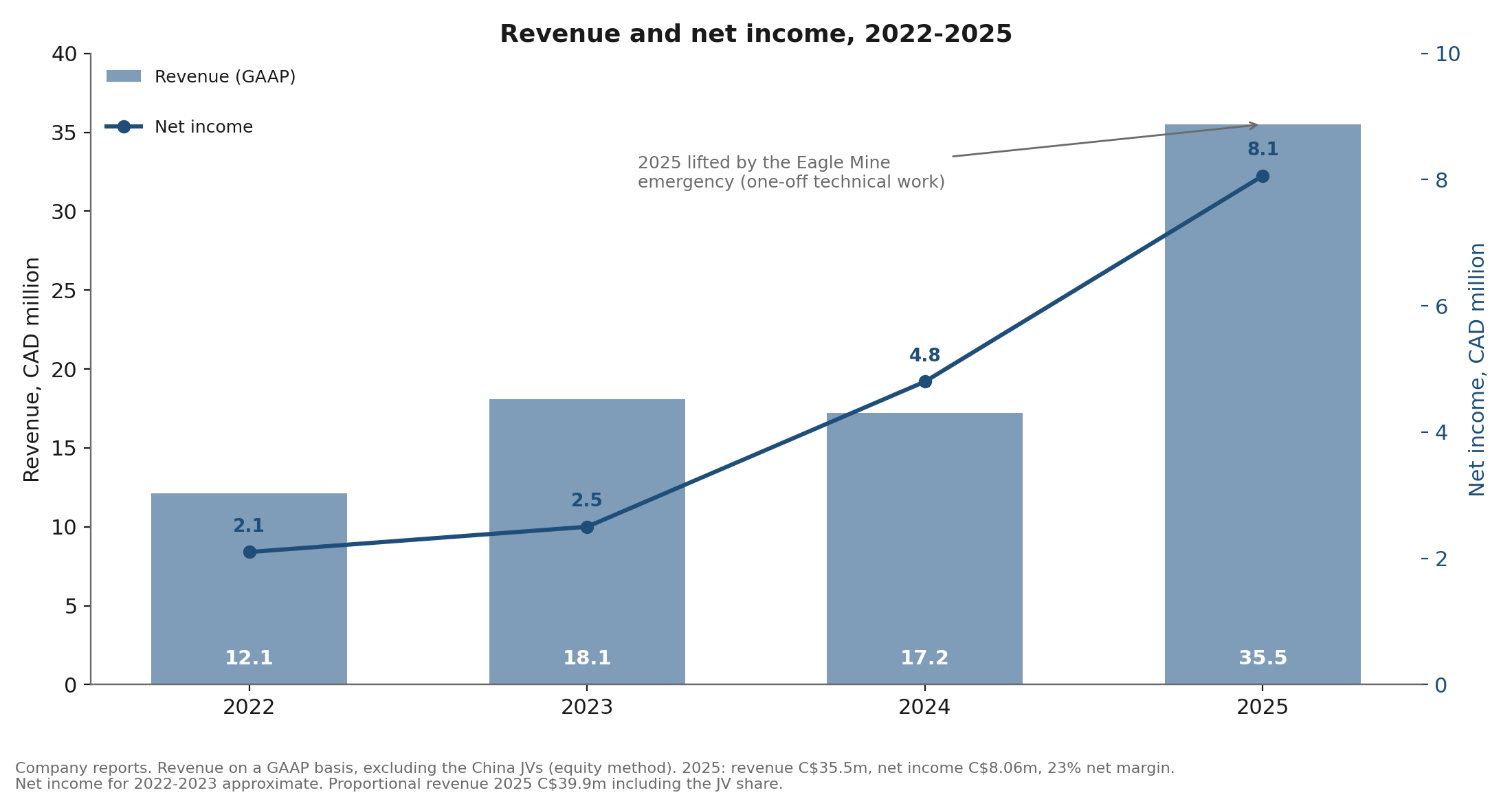
BQE Water designs, builds and then operates water-treatment plants for the metals mining, smelting and refining industry. The model is land-and-expand: win a feasibility study or an emergency job, prove the technology, then operate the plant for the 10-20 year life of the mine on recurring tolling and service fees. Twenty-five years of proprietary process IP (SART, Selen-IX, BioSulphide) sit behind a moat that is not really about technology: a mine that replaces the team which designed its cyanide-handling system to save 10-15% is trading a small cost saving against a spill, a regulatory shutdown and the reputational damage that follows. 2025 was a record year — revenue C$35.5m (+107%), net income C$8.1m (+68%), a 23% net margin — and the business now runs nine long-term sites across Canada, the US and China with no bank debt and ~C$19m of cash. Against ~C$90m of market cap (~C$71m EV net of cash), that is roughly 8-9x owner’s earnings for a business whose contracted operations book is larger going into 2026 than it has ever been. The headline that will confuse a first reading is the revenue mix: recurring work fell to 21% of 2025 revenue. That number is the denominator moving, not the business deteriorating, and the section below sets out exactly why.
The business: land, then expand

Headquartered in Vancouver, BQE serves metals mining, smelting and refining through two revenue streams that form a flywheel:
Technical services (the land phase). Feasibility studies, lab testing, pilot demonstrations, engineering design, plant commissioning. Non-recurring but strategic: it proves BQE’s capability on a specific site and embeds its institutional knowledge of that site’s chemistry.
Operations contracts (the expand phase). Once BQE designs and commissions a plant, it becomes the natural operator for the life of the mine — often 10-20 years — earning recurring revenue through per-cubic-metre tolling fees, fixed monthly fees, or operations-support fees.
A customer who hires BQE for a pilot is likely to hire it for design, then construction, then operations, because switching mid-stream means handing a complex system to a team that did not design it, in an environment where a single discharge failure is a licence-to-operate event.
The revenue mix: reading 2025 correctly
This is where a careless reading of the accounts produces the wrong conclusion, so it is worth doing properly. On a GAAP basis — which excludes the China JVs, accounted for by the equity method — the split between recurring operations and project technical services runs like this:
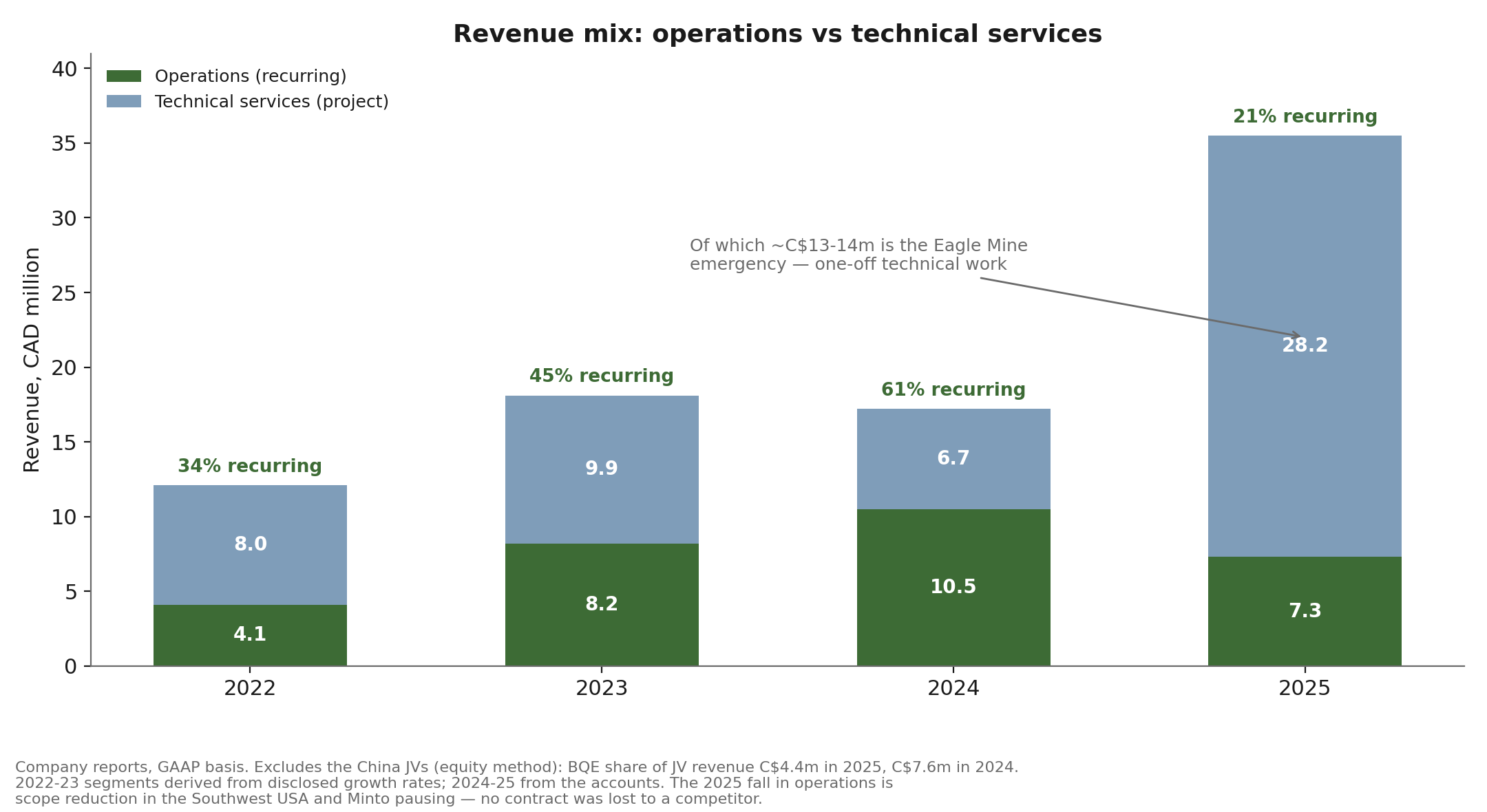
| Year | Revenue | Operations (recurring) | Technical services | Recurring |
|---|---|---|---|---|
| 2022 | C$12.1m | C$4.1m | C$8.0m | 34% |
| 2023 | C$18.1m | C$8.2m | C$9.9m | 45% |
| 2024 | C$17.2m | C$10.5m | C$6.7m | 61% |
| 2025 | C$35.5m | C$7.3m | C$28.2m | 21% |
Recurring revenue fell in 2025, both in absolute terms (C$10.5m to C$7.3m) and as a share of the total (61% to 21%). Anyone drawing a trend line through those percentages will conclude the recurring story is breaking. Four things say otherwise.
It is the denominator, not the numerator. Technical services quadrupled because of the Eagle Mine emergency, which management itself describes as a one-off and which accounted for roughly half of 2025 technical services — some C$13-14m. Strip Eagle out and the mix is C$7.3m of C$21m, about 34%, in line with the historical pattern.
No contract was lost to a competitor. The C$3.2m decline in operations has two identifiable causes, and neither is churn. In the Southwest USA, BQE moved from full operation to technical support from April 2025 — less revenue, better margin, fewer people committed. At Minto, the plant did not operate in 2025 because BQE’s own crew was redeployed to Eagle. Competitive losses in the year: none. The switching-cost argument was tested in 2025 and held.
The 2025 technical services book is the largest pipeline of future recurring work the company has ever built. The mechanism is proven: management attributes the doubling of recurring revenue in 2023 to technical services delivered in prior years. On that basis, C$28.2m of technical work in a single year is not a bad mix — it is the largest amount of seeding the business has ever done. Part of it converted within 2025: the Wharf plant was commissioned in October and began generating support fees in November (only 22 operating days sit in the 2025 figures), and a third Shandong Gold SART plant came under BQE supervision from October.
The trough in recurring coincided with the peak in everything else. In its weakest recurring year BQE posted record net income, lifted cash from C$11.8m to C$19.0m, brought an aquatic toxicology laboratory online, and grew its field operations team three-to-fourfold into the largest group in the company. The one-off work paid, without dilution, for the operating capacity the 2026 recurring book needs. And the recurring assets that did run, ran better: Raglan operated 240 days versus 202 the prior year, treating 26% more water.
The reversal is contracted, not forecast: Britannia (20 years, operating since January 2026), Nunavik Nickel (3 years), the Quebec lead smelter (2 years), with four further sites in active discussion. 2025 was the year recurring revenue bottomed by BQE’s own choice while the project business financed the next leg — the 21% is a photograph of the moment the seed was in the ground and the harvest had not yet come in.
One basis note, because mixing bases would be its own error: these figures are GAAP and therefore exclude the China JVs, which are recurring by nature but reported by the equity method (BQE’s share of JV revenue was C$4.4m in 2025 against C$7.6m in 2024). Measured on proportional revenue, recurring work is ~C$11.7m of C$39.9m, or roughly 29%.
Where BQE works
Each site is a multi-year contract that a competitor cannot take without the customer accepting a step-change in operational risk.
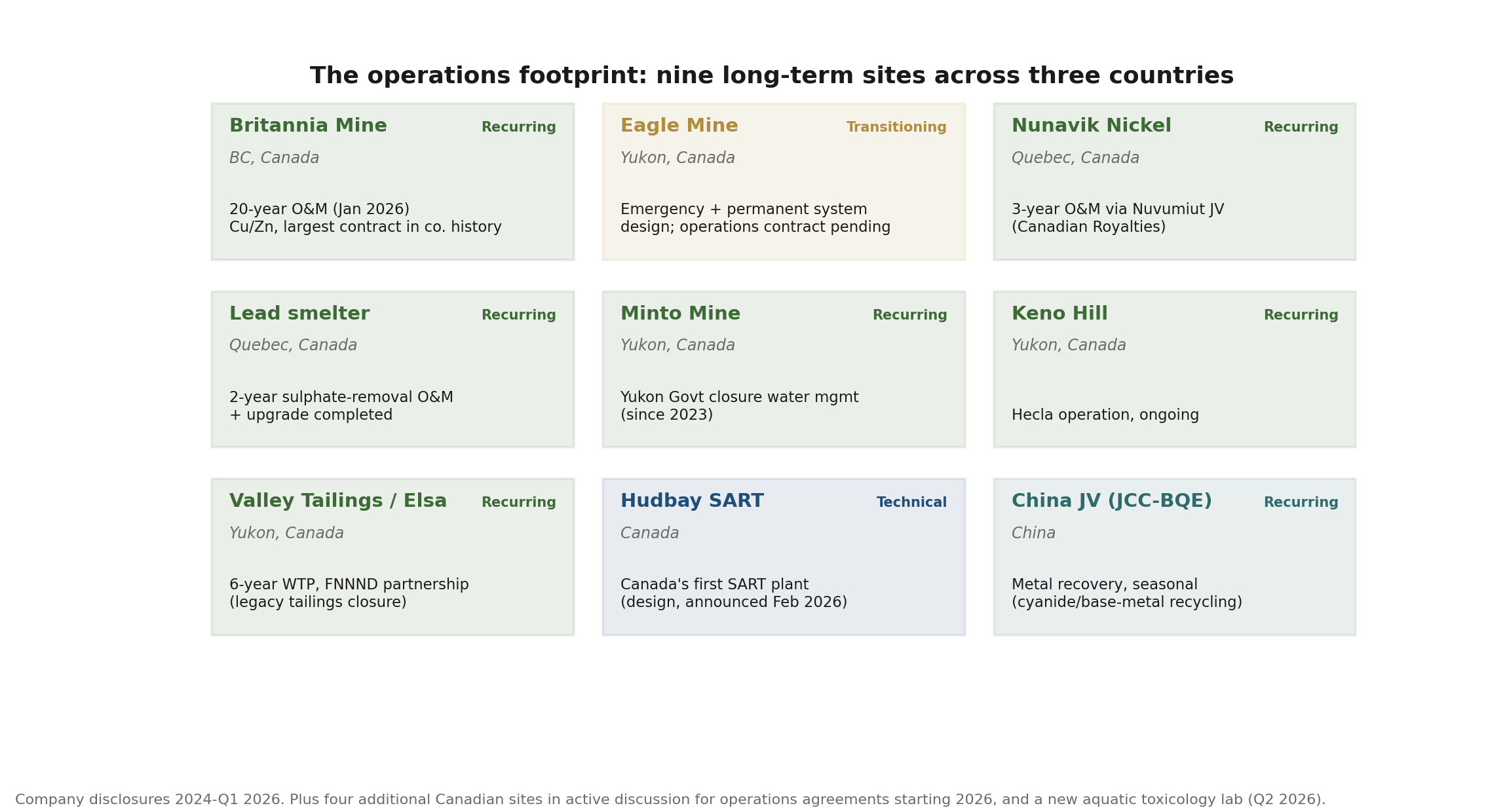
- Britannia Mine (BC). A 20-year operations-and-maintenance contract with the BC government, assumed January 13, 2026 — the largest in company history. A High-Density Sludge lime plant neutralizing acidity and removing copper and zinc from legacy underground workings before discharge into Howe Sound. Includes profit-sharing if BQE lowers historical operating costs. Transition completed in Q1 2026; the contribution becomes visible through 2026.
- Eagle Mine (Yukon). The emergency that made the 2025 numbers, now transitioning toward permanence. BQE designed the emergency system from scratch under crisis conditions, discharged over 1 million cubic metres of clean water safely, trained local First Nations operators, and is designing the permanent treatment system (engineering completing end of Q1 2026). The Victoria Gold receivership sale is active; whoever buys the mine inherits the water-treatment obligation, and BQE’s emergency record, permanent design and First Nations partnerships make it the likely candidate for the long-term operations contract (expected H2 2026-H1 2027).
- Nunavik Nickel (Quebec). A three-year O&M contract via the Nuvumiut Development JV (Canadian Royalties) — an Indigenous partnership model BQE is replicating across the north.
- Lead smelter-recycler (Eastern Canada / Quebec). A two-year operations-support arrangement on a sulphate-removal system BQE first upgraded (new stage to <1,500 mg/L discharge), then stayed to run.
- Minto Mine (Yukon). Closure water management for the Yukon government since 2023; idle in 2025 with the crew redeployed to Eagle.
- Keno Hill (Yukon). Ongoing operation (Hecla).
- Valley Tailings / Elsa (Yukon). A six-year water-treatment plant for the closure of a legacy tailings facility near Mayo, in partnership with the First Nation Na-Cho Nyak Dun — legacy-liability closure, a large and growing category.
- Hudbay SART (Canada). Canada’s first SART plant, design announced February 2026.
- China JV (JCC-BQE). Metal recovery from cyanide and base-metal streams; seasonal, and a modest 2025 contributor, but a live operation.
Behind the footprint: management is in active discussions for operations agreements at four additional Canadian sites starting in 2026, and a new aquatic toxicology laboratory came online in Q2 2026, adding specialized investigative testing to the land phase of the flywheel.
Potential sites: how the pipeline compounds
Each win creates the credential for the next. Three engines drive new-site conversion:
-
SART goes domestic. BQE’s board includes Chris Fleming, the inventor of SART (cyanide recovery in gold processing), and the company has designed or supervised a dozen SART plants globally. The Hudbay contract is Canada’s first SART plant, turning an internationally proven technology into a domestic reference case BQE can sell to Canadian gold mines fighting base-metal interference in cyanidation.
-
Selenium regulation is a growth market with a clock on it. Selen-IX removes selenium from mine water to sub-5-ppb levels. As selenium discharge limits tighten worldwide the addressable market grows mechanically, and BQE has shown (per the FY2025 commentary) that its selenium technology can take a mine from detailed engineering to compliant discharge inside 14 months.
-
The First Nations closure model. Eagle, Elsa/Valley Tailings and Nunavik share a template: partner with the local Indigenous development corporation, align on clean-water production, and win the long-term operations mandate on their traditional territory. Canada has a large inventory of legacy and closing mines requiring perpetual water treatment on Indigenous land, and BQE has made that a repeatable partnership model.
The five structural drivers
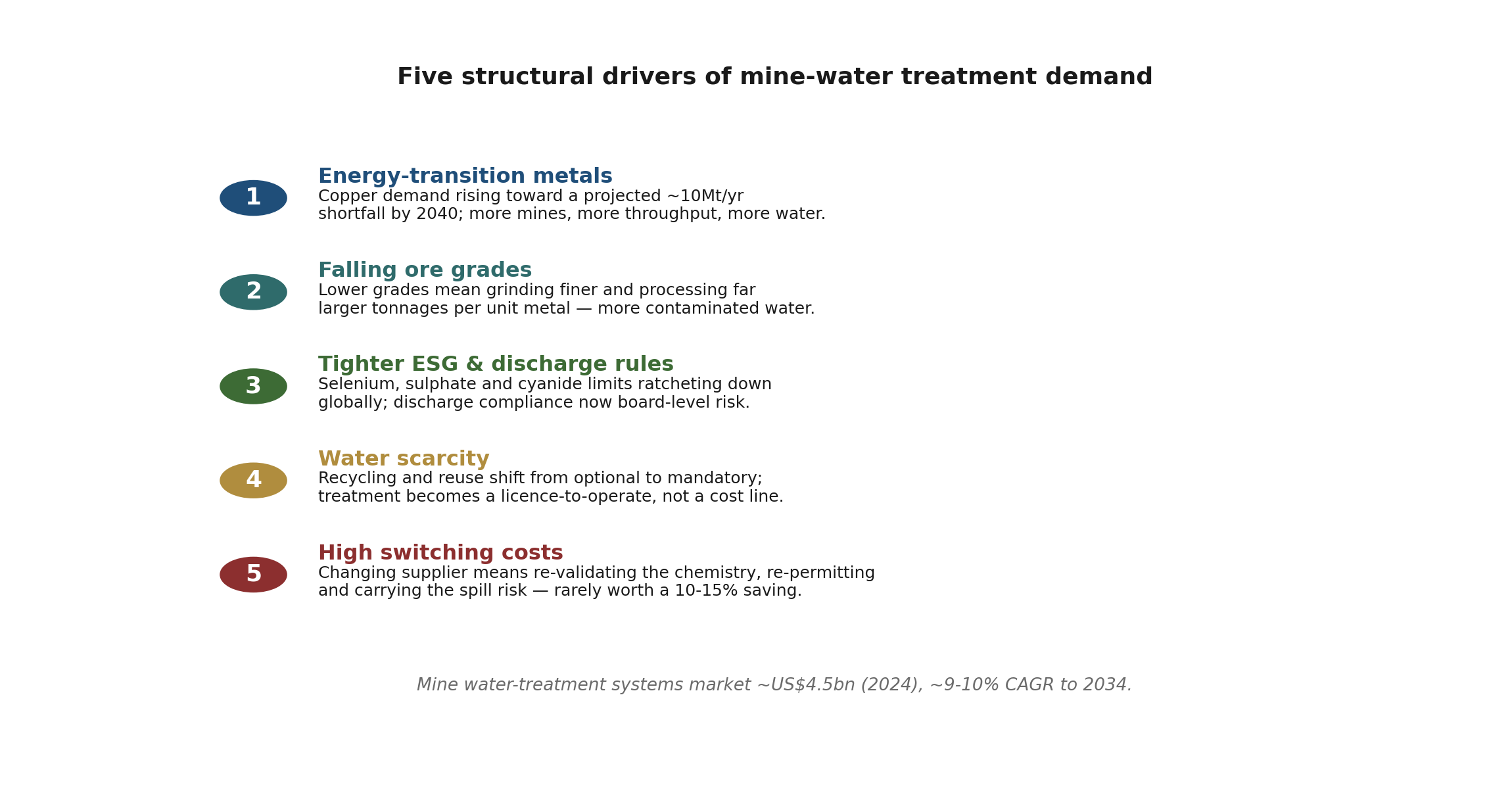
1. Energy-transition metals mean more mining. Electrification, grids, EVs and data centres are driving copper demand toward a projected shortfall of up to ~10 million tonnes per year by 2040 on current pipelines. More mines and higher throughput at existing mines both mean more contaminated water to manage. The mine water-treatment systems market was ~US$4.5bn in 2024 and is forecast to compound at roughly 9-10% into the 2030s.
2. Falling ore grades mean more water per unit of metal. Average copper ore grades are declining across the major producing regions. Lower grades force miners to grind finer and process far larger tonnages to extract the same metal — and larger tonnages mean proportionally more contaminated water, more complex chemistry, and more selenium, sulphate and cyanide to remove.
3. Tightening ESG and discharge regulation. Selenium, sulphate and cyanide discharge limits are ratcheting down globally, and water-discharge compliance has moved from an operational detail to a licence-to-operate risk. Every tightening of a limit expands the set of mines that need what BQE sells.
4. Water scarcity turns treatment into a licence to operate. As freshwater grows scarce in mining regions, recycling and reuse shift from optional to mandatory. Water treatment stops being a cost line to minimize and becomes infrastructure a mine cannot operate without — the kind of demand that supports 20-year contracts.
5. BQE’s switching costs. The four forces above grow the market; this one determines who keeps it. Replacing an incumbent water-treatment operator means re-validating the chemistry with a team that did not design it, re-permitting the discharge, and carrying the spill risk through the transition — at sites that often sit on First Nations territory under close regulatory scrutiny. A mine might save 10-15% by switching. The decision is therefore made on risk, not on price, which is why operations contracts, once won, tend to run for the life of the asset.
The moat, in one sentence
BQE combines patented process IP with switching costs that are decided on risk rather than price, in an asset-light model that needs almost no capital to grow.
Financials and the balance sheet
FY2025 audited: revenue C$35.5m (+107%), net income C$8.1m (+68%), 23% net margin, proportional revenue (including the China JV) C$39.9m (+61%), working capital C$21.4m (+70%). Owner’s earnings on a normalized run-rate sit around C$8-9m. The balance sheet carries no bank debt and an undrawn revolving facility, and cash rose from C$11.8m to C$19.0m over 2025 — better than a fifth of the market cap.
A necessary note on Q1 2026: revenue was C$4.8m with a small net loss (~C$1.3m). This is not deterioration — it is three things stacking in the seasonally weakest quarter: Eagle ran only one month of treatment (the successful cleanup meant the system did not need restarting until March), Britannia carried one-time transition costs from taking over the plant, and head-office and lab investment stepped up for the growth plan. Q1 is structurally BQE’s weakest quarter every year (northern-hemisphere winter idles several sites; the China JV is in its dry season). The full-year 2026 setup — a full year of Britannia, the Quebec and Nunavik contracts, and Eagle’s permanent transition — is what matters.
Valuation
At ~C$71m EV against C$8-9m of owner’s earnings, BQE trades near 8-9x. That multiple embeds an assumption that 2025 was the peak and the business flattens or declines from here. What the contracts say is the opposite: Britannia is a 20-year agreement that only began operating in January 2026, the Quebec and Nunavik contracts run for two and three years respectively, and four further sites are in discussion — so the recurring book entering 2026 is the largest in the company’s history at the exact moment the reported mix looks worst.
In a probability-weighted case where Britannia ramps, Eagle converts to a permanent contract and one or two pipeline projects land, owner’s earnings settle in the C$9-12m range. What multiple that deserves is a judgement rather than a calculation, but a business with 10-20 year contracted revenue, no debt, no meaningful capital intensity and a net-cash position worth a fifth of the market value is not obviously a single-digit-multiple asset. The downside is buffered by ~C$19m of net cash and an operations book that does not evaporate; the upside does not require the SART or selenium optionality to work.
Risks, honestly weighted
- Customer concentration. The top four customers were 77% of 9M-2025 revenue, with Eagle a large share. Loss of Eagle without replacement would be material — mitigated by the permanent-system design position and the broadening operations book, but real.
- Key-man risk. CEO David Kratochvil has been central to the turnaround. In a business built on institutional knowledge and relationships, that concentration cuts both ways.
- Eagle is not yet signed for permanence. The receivership sale must complete and the buyer must award the long-term contract. BQE is the likely candidate, not the incumbent by right.
- The recurring book has to actually convert. The 2026 reversal rests on Britannia ramping as contracted and the pipeline sites signing. If operations revenue does not recover in 2026, the benign reading of the 21% mix is wrong and the thesis weakens materially.
- China JV variability. JCC-BQE swings with weather and commodity prices; BQE’s share of JV revenue fell from C$7.6m to C$4.4m in 2025.
- Microcap illiquidity is a two-way street. The same thin float that suppresses the multiple makes this a long-term ownership stake, not a trade — position sizing and patience matter.
- Recent SEC registration filings. BQE filed registration statements in late 2025 and 2026; worth watching for any equity issuance that could dilute a very tight share count.
What has to be true for this to lose money
A permanent capital loss from ~C$90m requires Eagle to disappear without replacement, Britannia and the new Quebec/Nunavik contracts to underdeliver, the pipeline to stall, and the structural drivers to reverse — all against a net-cash balance sheet and an operations book with 10-20 year contract lives at sites where switching is a risk decision. The evidence points the other way on each count. Asymmetry, not a growth forecast, is the thesis.
Catalysts
- Eagle permanent operations contract (H2 2026-H1 2027): the receivership sale completing and the long-term award converting a project into a decade-long annuity.
- Britannia ramp: a full year of the largest contract in company history becoming visible in 2026 results, with profit-sharing upside if BQE cuts legacy operating costs.
- The 2026 mix reversal: the first full year in which Britannia, Nunavik, the Quebec smelter and the Wharf support fees all report together should take recurring revenue to a record, and settle the 2025 mix question in the numbers rather than in argument.
- Hudbay SART execution: Canada’s first SART plant as the reference case for Canadian gold mines with base-metal interference.
- Four pipeline sites converting to operations agreements through 2026.