
AIM · Building services
Northern Bear: an £86m-revenue business priced like it's going bankrupt
Specialist UK building services: cash generation, capital allocation and the limits of the regulatory investment case.
Share price
Since purchase
Price in local currency, excluding dividends. Latest available quote; may be delayed.
The thesis in three points
- Opportunity
- Specialist construction and maintenance services with disciplined capital allocation.
- Key assumption
- Demand translates into profitable work; regulation alone guarantees neither orders nor margins.
- What to monitor
- Cash conversion, working capital, subsidiary margins and dividend coverage.
Valuation and prices refer to the original analysis date. Subsequent updates are identified separately.
In this analysis
Published July 2026. Market cap ~£15.4m (~112p, ~13.76m shares); net cash £6.2m; EV ~£9m. Reasoning in enterprise value, owner’s earnings and returns on capital — no EBITDA.
The one-paragraph version
Northern Bear generated £86m of revenue in the year to March 2026, earns a ~30% return on capital employed, carries zero bank debt and £6.2m of net cash, and trades at roughly 5x earnings. It is not a fraud, not distressed, not in a shrinking sector — it is a decentralised holding company of ten autonomous building-services subsidiaries in Northern England, and it is small enough (~£15m market cap) that institutions structurally cannot own it. Meanwhile its demand is being written into law: the Building Safety Act, Awaab’s Law and decarbonisation targets create mandatory, non-discretionary, multi-year work for exactly what its companies do. FY26 confirmed the thesis is compounding, not fading — revenue +10.2%, gross margin to 25.5%, operating profit £5.1m, net cash nearly tripled year on year, and both the ordinary and special dividends raised. You are paying less, in P/E terms, than management paid to buy back a quarter of the company two years ago — on higher earnings, with a cleaner balance sheet, and with the demand mandated by statute.
What Northern Bear is — and why the holding structure matters
Northern Bear is not an operating company; it is a holding company headquartered in Newcastle that owns ten autonomous subsidiaries, each with its own managing director running the business day-to-day, reporting up to group CEO John Davies. The parent provides strategy and financial consolidation and almost nothing else — central cost is roughly £1.5m against £86m of revenue.
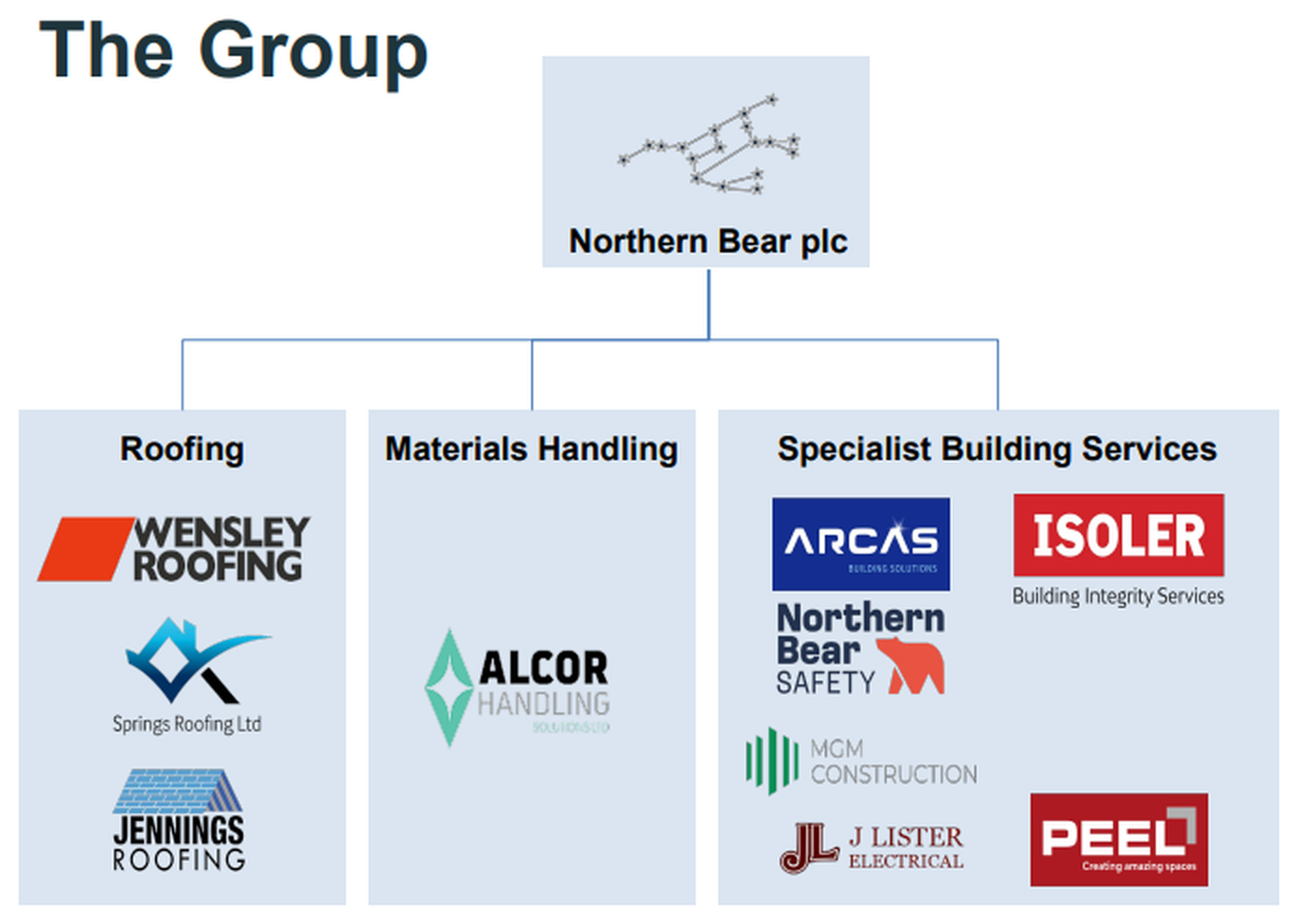 Northern Bear’s own group chart. H Peel & Sons still appears on it: the diagram predates the 2025 closure, when its contracts and customers moved across to Arcas.
The model matters because building services is a business of local relationships, site knowledge and operator judgement. A centralised roll-up destroys exactly what makes each firm valuable; a federation of owner-operators preserves it. Each MD knows their patch, their clients, their crews. The parent’s job is capital allocation — decide which subsidiaries deserve investment, which can be bolted onto, and which no longer earn their place. Three divisions:
Roofing (£33m FY25 revenue, £2.5m divisional operating profit). Five companies — Springs Roofing, Wensley Roofing, Jennings Roofing and others — providing slating, tiling, leadwork, refurbishment and maintenance for social housing, local authorities and housebuilders. The recent push into solar PV roofing has added revenue and lifted margin: the same crews on the same roofs, now installing a higher-value product.
Specialist Building Services (£41m FY25 revenue, £2.0m divisional operating profit). This is the growth engine. Isoler does passive fire stopping — the business that has exploded post-Grenfell, and the group’s single most important asset; it relocated to larger premises in Durham in late 2024 specifically to support growth. Alongside it: Arcas Building Solutions (general building services), MGM Construction (specialist construction and refurbishment), J Lister Electrical, and Northern Bear Safety (health-and-safety advisory, which also accredits the whole group to CHAS Elite). The division’s FY25 operating profit was depressed by ~£0.9m of losses and closure costs at H Peel & Sons — which brings us to the most underrated feature of the structure.
Materials Handling (£3.7m FY25 revenue, £0.4m divisional operating profit). Alcor Handling Solutions: forklift sales, hire, service and operator training. Small, consistently profitable, with recurring hire streams that add ballast.
H Peel & Sons: why closing a subsidiary is a feature, not a failure
In early 2025 the group announced the closure of H Peel & Sons, the interior design and fit-out business it had acquired in 2017. Its core end markets — leisure and hospitality — never recovered from the aftermath of the pandemic, and the subsidiary could not be brought back to profitability. The decision cost ~£0.9m in losses and closure charges, denting the Specialist Building Services division’s headline profit.
The instinctive read is a failed acquisition. The more useful read is what management did with the pieces. The customer relationships and the live contract book were not written off: the business and its ongoing contracts were folded directly into Arcas Building Solutions, another group subsidiary, so the clients and the work stayed inside the group. The physical asset was recycled too. Dewlon House, H Peel’s premises in Dewsbury, West Yorkshire, did not sit empty — in February 2026 Jennings Roofing relocated its head office and operations there from Leeds.
So the £0.9m was the cost of exiting a market that no longer worked, not of destroying an asset base. The customers moved to a subsidiary that could serve them, the building now houses a growing roofing business, and the loss-making cost structure is gone.
The wider point is what this says about the parent. A federation of ten subsidiaries is a portfolio, and capital allocation cuts both ways: it means backing winners like Isoler with new premises and growth investment, and cutting off a subsidiary that no longer earns its cost of capital rather than letting it bleed. Most small-cap conglomerates fail precisely because management falls in love with every business it owns and subsidises the losers with the cash the winners generate — the classic value-destroying “diworsification” Peter Lynch warned about. Northern Bear identified an underperformer, closed it cleanly, kept what was worth keeping, and took the one-time hit. That £0.9m drag makes the underlying run-rate of the division materially higher than the FY25 headline suggests.
The regulatory tailwind that cannot be legislated away
Northern Bear sits at the intersection of three regulatory forces creating mandatory, non-discretionary demand for exactly its services. These are not cyclical tailwinds; they are structural, multi-year and bipartisan.
Building Safety Act 2022 (post-Grenfell). The 2017 Grenfell Tower fire killed 72 people. The Act that followed made building owners personally accountable for safety, creating enormous demand for passive fire-stopping remediation — Isoler’s core work. The company’s own investor material is blunt: “Grenfell effect — driving opportunities in all sectors” and “tier-one contractor remedial works — negotiated works rather than tender.” Negotiated work means higher margins and less competition: when a tier-one contractor needs fire stopping on a remediation project, they go to firms they know and trust, not to the lowest bid. This is repeat, relationship-driven work with pricing power.
Awaab’s Law. Awaab Ishak was two years old when he died in 2020 from mould exposure in Rochdale social housing. The law bearing his name came into force on 27 October 2025, mandating strict timeframes for social landlords to investigate and remediate hazards. England has ~4.5 million social homes; landlords must investigate reported hazards within 10 working days and make properties safe within 5 (24 hours for emergencies), with non-compliance exposing them to court action and compensation. Phase 1 (Oct 2025) covers damp, mould and emergency hazards; Phase 2 (2026) adds excess cold/heat, falls, structural collapse, fire and electrical hazards; Phase 3 (2027) covers everything remaining. This is not deferrable capex — it is legally mandated remediation on a housing stock starved of investment for decades, and it lands directly on Northern Bear’s roofing and building-services divisions.
Decarbonisation. UK net-zero and energy-efficiency targets drive demand for solar PV, insulation and building-envelope work. Northern Bear has PV-certified its roofing crews and positioned J Lister for related electrical work.
The Building Safety Act has bipartisan support, Awaab’s Law expands in scope through 2027, and decarbonisation extends to 2050. This is demand visibility that runs far beyond a normal construction cycle — the work is being written into statute.
FY26 results: the thesis compounding, not fading
The full-year numbers to 31 March 2026 (unaudited prelims, reported July 2026) confirmed the step-change is durable rather than a one-off spike:
- Revenue £86.1m, +10.2% (from £78.1m).
- Gross profit £22.0m, +14.6%; gross margin 25.5% — up again, and up faster than revenue.
- Operating profit £5.1m (from ~£3.8m adjusted in FY25).
- Adjusted basic EPS 22.7p, +17.6%.
- Net cash £6.2m, up from £2.5m a year earlier — nearly tripled.
- Achieved despite a tougher H2: adverse Northern England winter weather and wider macro pressure on the private commercial side, offset by the structural public-sector remediation growth.
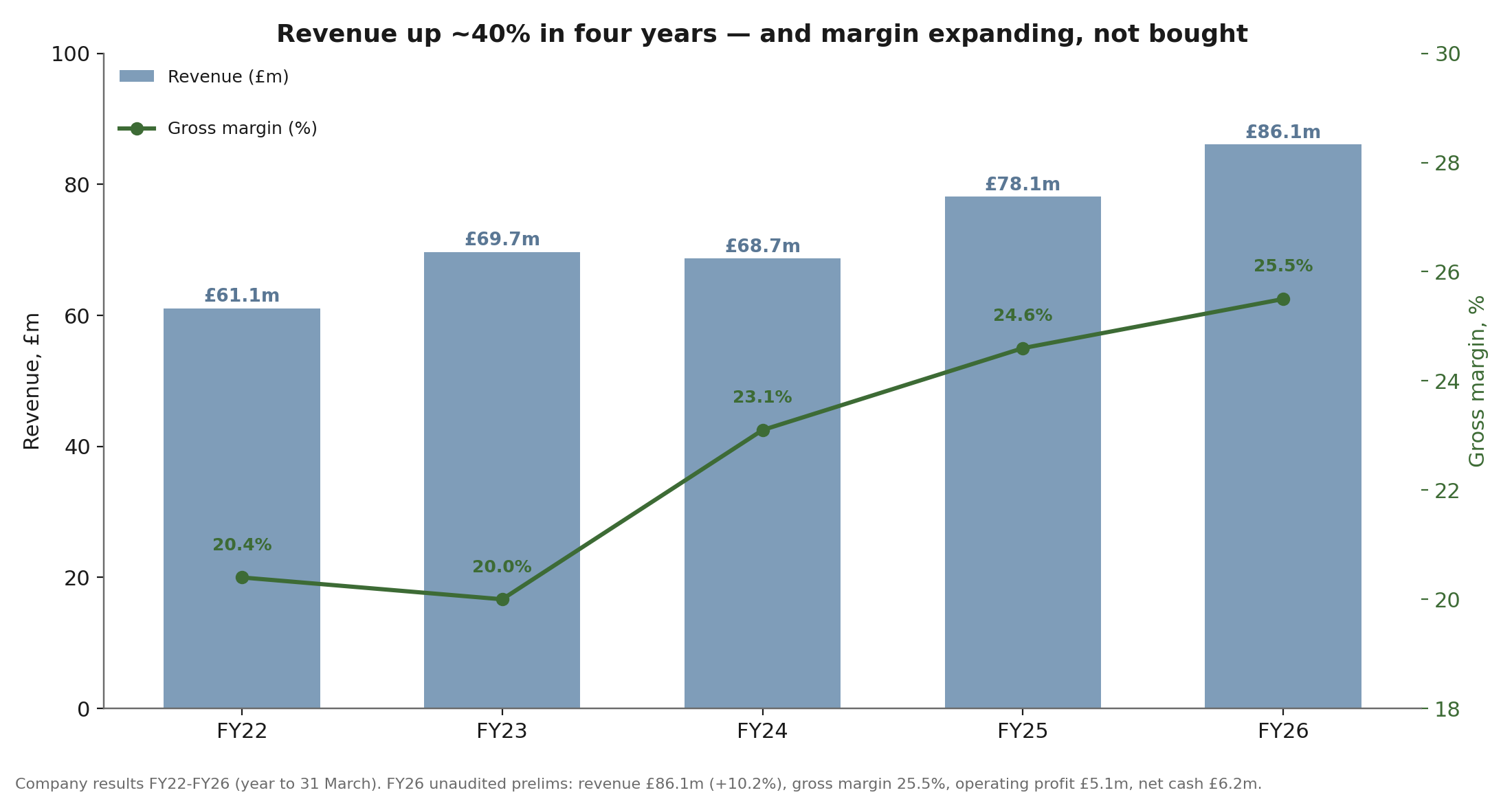
Gross margin has climbed from 20.4% (FY22) to 25.5% (FY26) — this is not revenue growth bought by cutting price; it is a deliberate mix shift toward fire stopping, solar PV and better contract selection. Revenue up ~40% in four years and five points of gross margin is genuine operating quality, not volume for its own sake.
The dividend and the balance sheet
The board raised shareholder returns on the back of FY26. It proposes a final ordinary dividend of 2.5p plus a special dividend of 5.0p per share (payable 24 September 2026), against the 2.5p ordinary + 1p special paid for FY25 — the 5p special explicitly reflecting the non-recurring profit. Equity dividends paid in the year rose ~67% to £0.5m, and the board reaffirmed a progressive ordinary-dividend policy. On the current ~112p, the proposed 7.5p total is a ~6.7% yield; even the ordinary 2.5p alone is a well-covered, growing base.
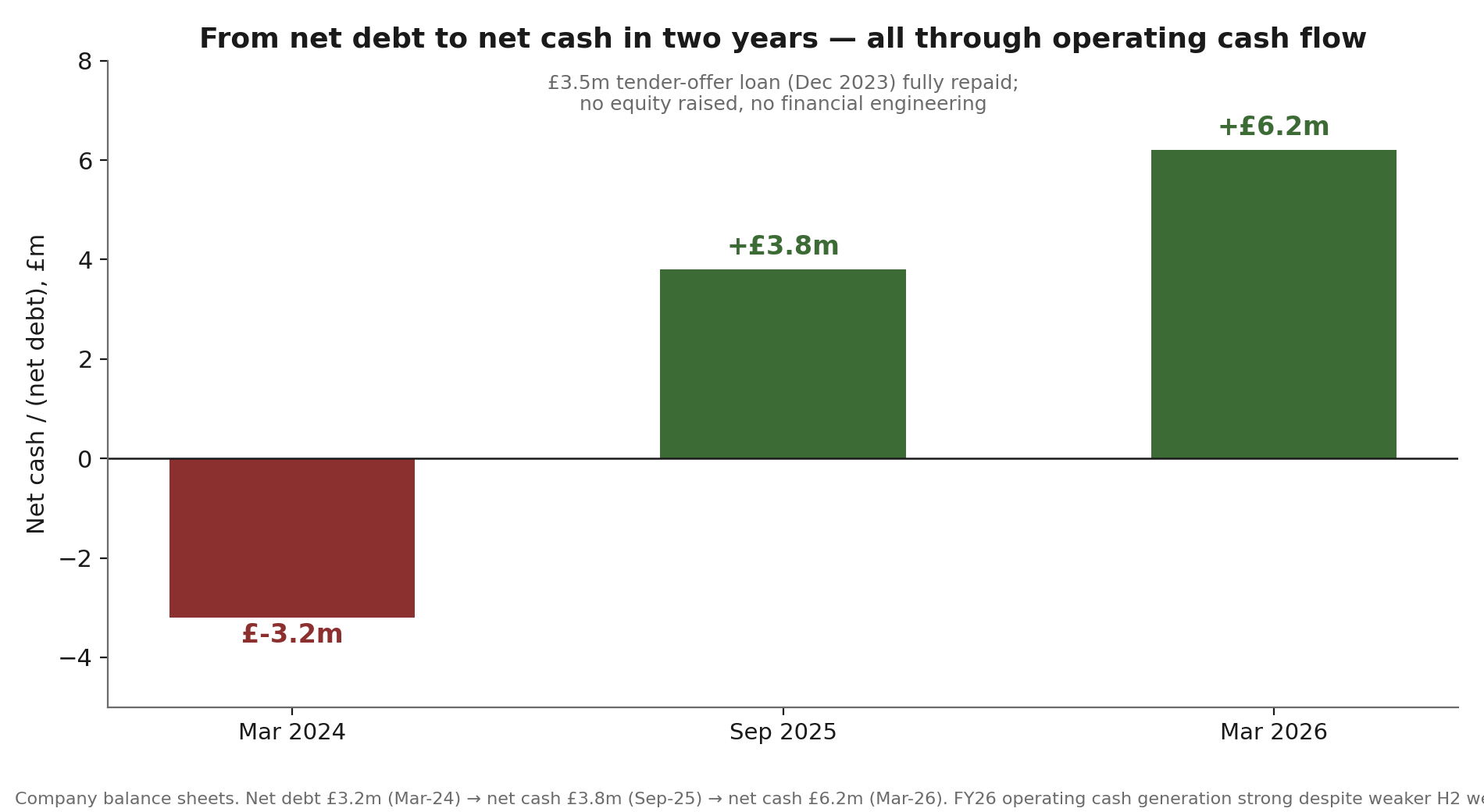
The balance sheet is the cleanest in the company’s history. Net cash of £6.2m at March 2026, up from net cash of £3.8m in September 2025 and net debt of £3.2m as recently as March 2024 — a swing of nearly £10m in two years, entirely through operating cash flow. Net assets are ~£24.8m, of which ~£15.4m is goodwill from acquisitions made between 2006 and 2020; impairment testing uses a 13.4% discount rate and 2% terminal growth, and sensitivity analysis shows a simultaneous 2% higher discount rate and 2% lower growth would still trigger no impairment. There is no financial engineering here — just a business that converts profit to cash, which is far from guaranteed in construction.
The capital-allocation record
Two data points tell you how management thinks. First, the December 2023 tender offer retired ~5 million shares — about a quarter of the company — at 62p, funded by a £3.5m term loan since fully repaid from operating cash flow. Management bought back a quarter of the business at roughly 6x earnings using borrowed money it cleared in under two years. Second, the H Peel closure above: the willingness to cut a losing subsidiary rather than subsidise it, while keeping its customers and premises working inside the group.
Valuation
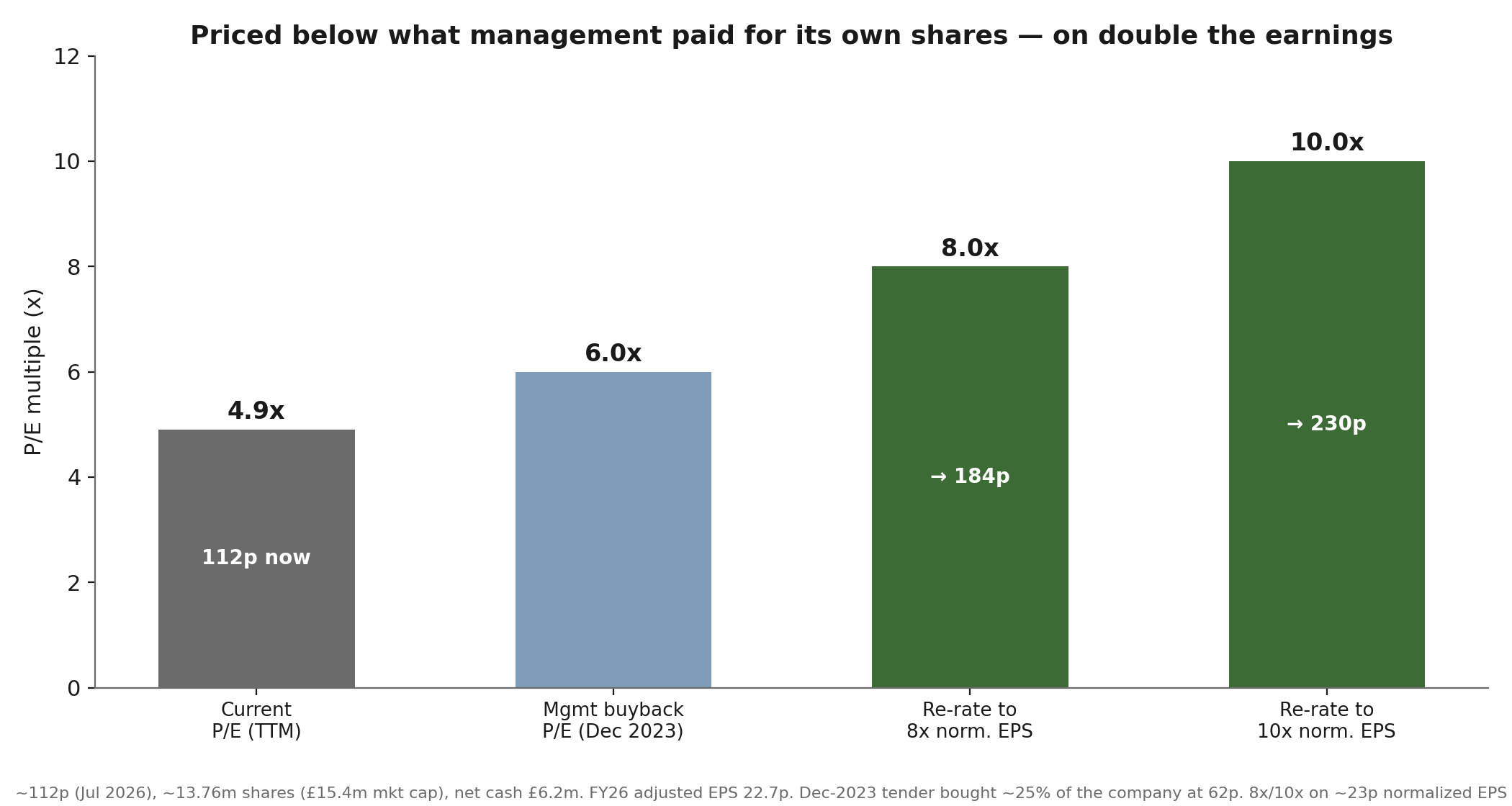
At ~112p with ~13.76m shares, the market cap is ~£15.4m and EV about £9m net of cash. On FY26 adjusted EPS of 22.7p that is roughly 5x earnings; on EV against operating profit or cash generation it is lower still, and the price sits at roughly 0.6x net assets. An enterprise value of under £10m for a business doing £86m of revenue at 25%+ gross margin and a ~30% return on capital.
The clearest yardstick is management’s own behaviour. It bought back a quarter of the company at 62p in December 2023, when earnings were roughly half today’s. At ~112p you are paying a lower P/E than management paid for its own shares two years ago, on roughly double the earnings. A P/E of 8x on ~23p of normalized EPS implies ~184p; 10x implies ~230p. Neither is aggressive for a business growing revenue at double digits with expanding margins, net cash and statute-mandated demand visibility through 2027. Fair value sits in the ~200-280p range — roughly 80-150% above the current price — with the downside cushioned by net cash, a tangible asset base and a covered, growing dividend.
Why is it cheap?
All the reasons are temporary and none is about business quality:
- AIM microcap illiquidity. The stock barely trades; institutions with minimum market-cap mandates are structurally excluded; building or exiting a position takes weeks.
- UK construction is genuinely having a hard time — and Northern Bear is being tarred with it. The sector backdrop is bad: insolvencies among contractors, weak private housebuilding, commercial work deferred, and firms squeezed between fixed-price contracts and cost inflation. The market sees “small UK building company on AIM” and applies the sector’s multiple without asking what the revenue actually is. But Northern Bear’s demand is increasingly regulation-driven and non-discretionary — a social landlord must remediate damp and mould within a legal deadline whether or not the economy cooperates — and the numbers show the divergence: revenue +10.2% and gross margin up again in a year the sector spent under real pressure. The private commercial softness the company flagged is real, but it is the smaller half of the business, and the mandated public-sector work is the half that is growing.
- The non-recurring distraction. FY26 (and the prior H1) included non-recurring profit, which makes headline numbers look unsustainably good and breeds scepticism about the run-rate. But even fully normalized, the multiple is mid-single-digit.
- No coverage. Broker research exists (Hybridan), but institutional awareness is effectively zero. A £15m company that does not do roadshows or conferences and publishes results twice a year is simply invisible.
Risks, honestly weighted
- Goodwill concentration. ~£15.4m of goodwill on ~£24.8m of net assets — over 60% of book value is intangible. A subsidiary blow-up would force impairment. The current profitability of all remaining CGUs and the sensitivity analysis make near-term impairment unlikely, but the risk is real.
- Key-person risk. The decentralised model means each subsidiary depends on its MD; losing a strong operator hurts. Mitigated by succession planning and newly issued options (900,000 at 52p, three-year vesting) — and, notably, the group has already navigated MD transitions at Arcas, MGM and Alcor.
- Controlling shareholder. NA Beaumont-Dark holds ~24% with significant influence. Interests appear aligned (the tender benefited all participants), but concentrated ownership is always a governance consideration.
- Sector exposure is not zero. The regulated work is what makes the thesis, but roughly half the group still touches private commercial and housebuilder demand. A deep enough UK construction downturn would hurt that half — H Peel is the proof that end-market collapse can take a subsidiary with it.
- Seasonality and lumpiness. H2 is historically weaker in Northern England on winter weather — FY26 showed exactly this. Quarterly results are volatile; this is not predictable monthly revenue.
- Liquidity. This is a long-term ownership stake, not a trade; position sizing must reflect that the stock does not really trade.
What has to be true for this to lose money
A permanent capital loss from ~£15m requires the regulation-mandated demand to reverse (against three laws expanding in scope), margins to collapse (against five straight years of expansion), the subsidiaries to blow up simultaneously (against a management team that closes losers early), and the net cash and dividend to somehow not matter — all while the business trades below its own tangible-asset-plus-goodwill base and below the price management itself paid on half the earnings. The evidence points the other way on every count. Asymmetry, not a growth forecast, is the thesis.
Catalysts
- FY26 results already delivered the proof: £86m revenue, £5.1m operating profit, net cash £6.2m, dividends raised. Each further clean period narrows the gap between fundamentals and price.
- Awaab’s Law Phase 2 (2026) and Phase 3 (2027) each expand mandatory demand; Isoler is investing in compliance capacity to capture it.
- The dividend: a growing ~6-7% total yield on a debt-free business will eventually pull in income-oriented capital that does not care about liquidity.
- Acquisitions: net cash plus strong generation equals capacity, and the stated criteria (established, profitable, cash-generative, well-managed) suggest discipline over empire-building.
- Simple re-rating: at some point a business compounding at double digits with a 30% ROCE and net cash does not trade at 5x, and someone notices.