
Euronext · Automotive
Renault Group: paying €7.5bn for €11bn of financial assets, factories included for free
A sum-of-the-parts case: financial assets, the industrial business and the discounts needed to value Renault without counting capital twice.
Share price
Since purchase
Price in local currency, excluding dividends. Latest available quote; may be delayed.
The thesis in three points
- Opportunity
- A possible discount between market capitalisation and the value of individual holdings and businesses.
- Key assumption
- Parts can be realised without double counting, allowing for taxes and capital requirements.
- What to monitor
- Automotive cash separate from financing, industrial margin, dividends received and European competition.
Valuation and prices refer to the original analysis date. Subsequent updates are identified separately.
In this analysis
Published July 2026. Market cap at publication: ~€7.5bn (~290m shares). All reasoning in market cap and enterprise value terms.
The one-paragraph version
Renault trades at ~€7.5bn. My sum-of-the-parts, built division by division with deliberately pessimistic assumptions, lands at €23–26bn after a 20% conglomerate discount. The excess net cash, the Nissan stake, the captive finance arm and the 45% stake in the Horse Powertrain JV — the pieces that require no belief in car manufacturing whatsoever — already add up to roughly €11bn on conservative marks. At today’s price, the market is not just valuing the industrial business at zero; it is valuing it meaningfully below zero. And this for a group that just printed a 6.3% operating margin, €1.5bn of automotive free cash flow, and grew revenue 7.3% in Q1 2026.
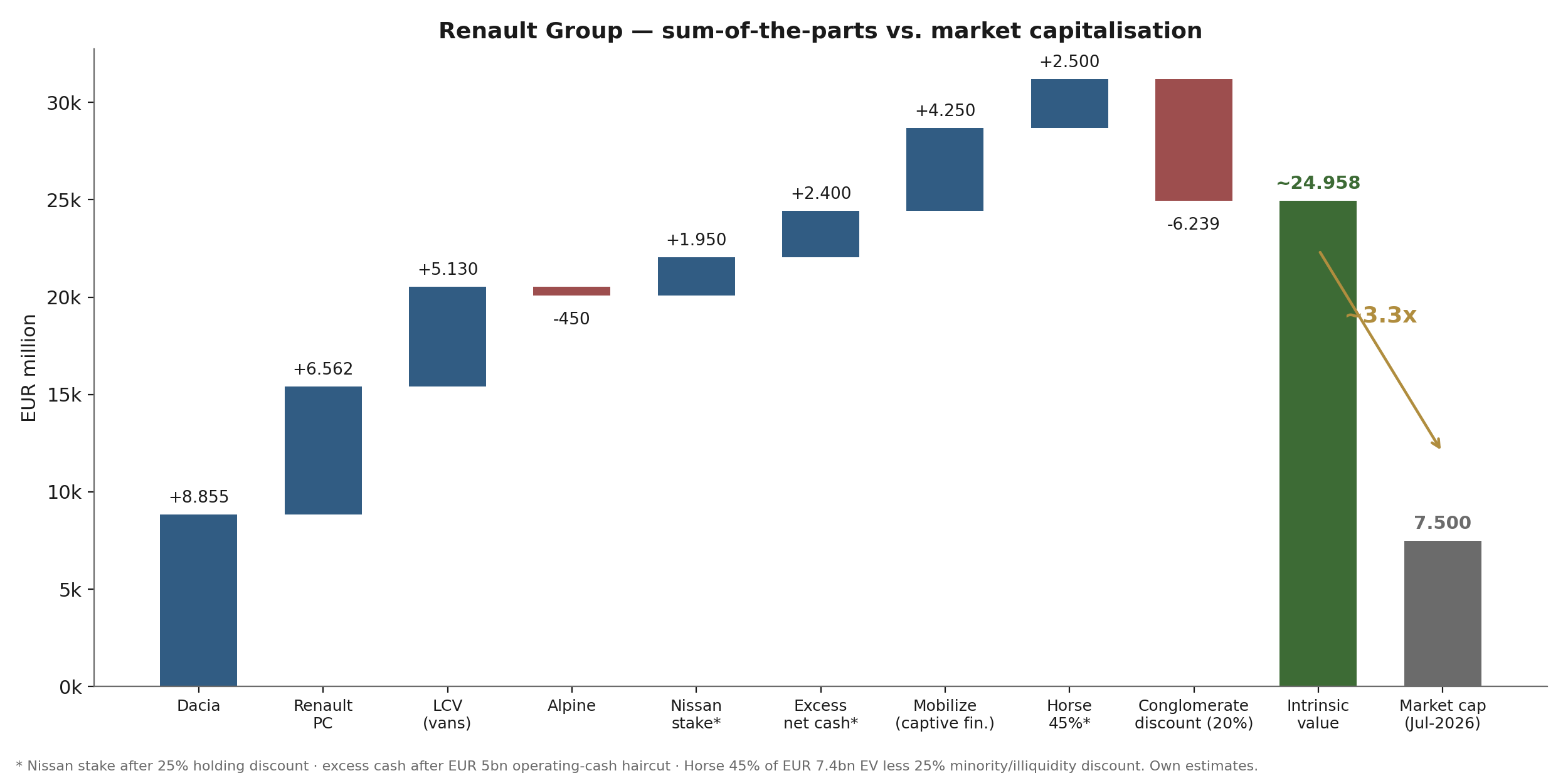
Sum of the parts
I value each business on normalized EBIT and multiples appropriate to its economics — no consolidated shortcuts, no EBITDA.
| Segment | Basis | Value (€m) |
|---|---|---|
| Dacia | ~€11.5bn revenue, ~11% EBIT margin, 7x EV/EBIT (retail-only channel, factories >130% utilization) | 8,855 |
| Renault passenger cars | ~€37.5bn revenue, 5% margin, 3.5x | 6,562 |
| Light commercial vehicles | ~€11.4bn revenue, 9% margin, 5x (B2B stickiness) | 5,130 |
| Alpine | ~€150m annual operating losses, 3x penalty | -450 |
| Nissan stake (direct + trust) | Market value less 25% holding/liquidity discount | 1,950 |
| Excess net cash | €7.4bn reported less €5bn treated as untouchable operating cash | 2,400 |
| Mobilize Financial Services | ~€850m recurring net income at 5x | 4,250 |
| Horse Powertrain (45%) | €7.4bn EV mark (Aramco entry), less 25% minority/illiquidity discount | 2,500 |
| Gross SOTP | ~31,200 | |
| Conglomerate discount (20%) | -6,240 | |
| Intrinsic value | ~25,000 |
Range with a 15–25% discount: €23.4–26.5bn. Against €7.5bn, that is roughly 3.3x, with the downside protected by assets that do not depend on selling a single car.
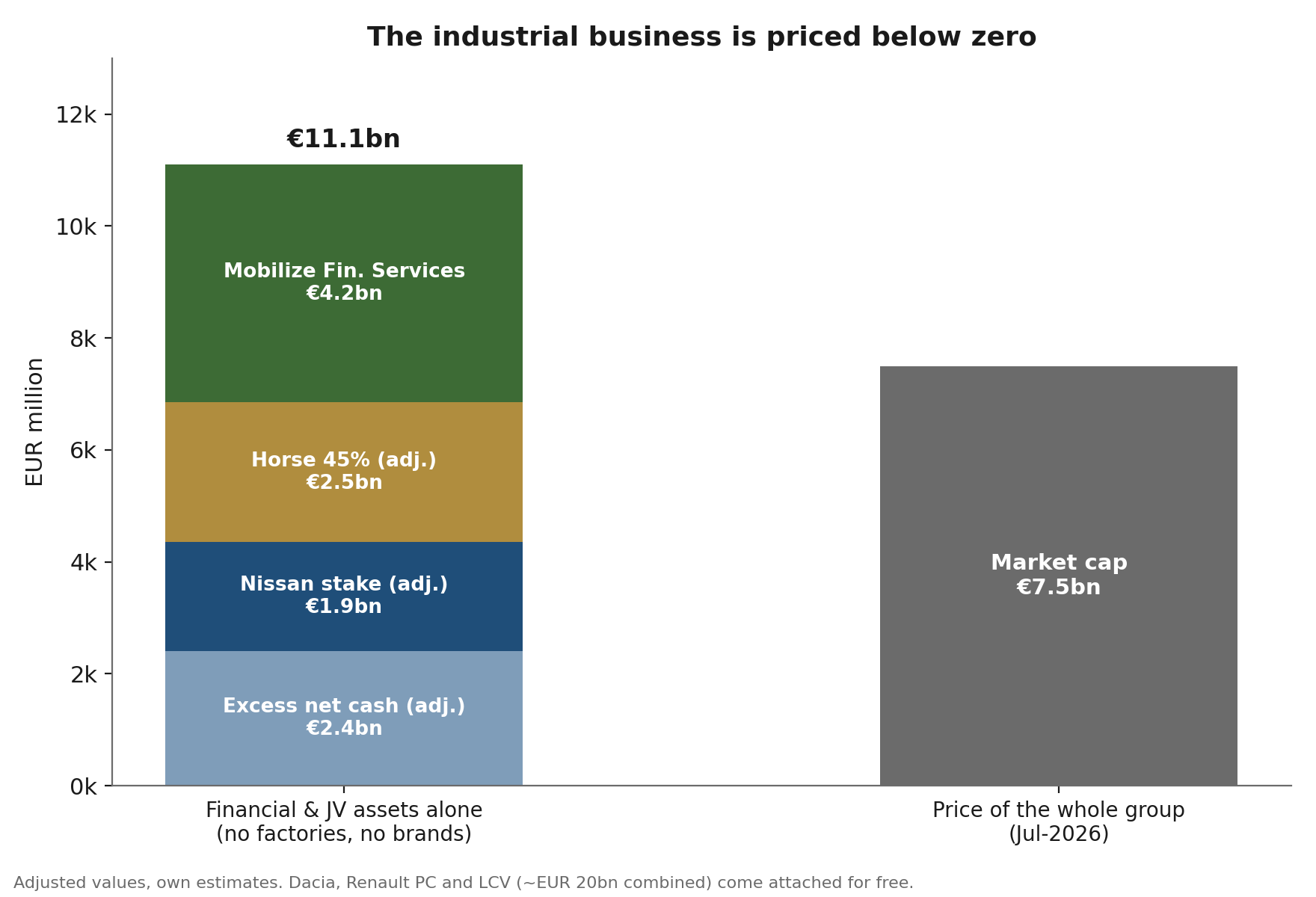
The €7.4bn of automotive net cash deserves its own caveat, and I have applied it: carmakers collect cash on delivery and pay suppliers at 60–90 days, so a large slice of reported net cash is trapped working capital. I sequester €5bn — roughly 9% of automotive revenue — and count only €2.4bn as genuinely excess. Note the direction of travel: net cash rose in 2025, from €7.09bn to €7.37bn. Companies being destroyed by competition do not grow their net cash position.
The 2025 headline net loss of €10.9bn is the number that scared the screen-scanners. It is almost entirely the non-cash consequence of moving the Nissan stake from equity-method accounting to fair value: a €9.3bn remeasurement charge plus €2.3bn of negative Nissan contribution. Strip Nissan and net income was positive (~€0.7bn). The write-down actually helps the thesis — the balance sheet now carries Nissan at market, so that source of negative surprises is spent.
What you are actually buying, piece by piece
Dacia (€8.9bn) — the anti-crisis bunker. Dacia is not “a cheap car brand”; it is the most profitable volume machine in European autos. It sells almost exclusively to retail customers — no rental-fleet dumping, no self-registrations, no discount channel — so every car goes out at sticker price, and its plants run above 130% utilization, spreading fixed costs thinner than any competitor. Margins are already double-digit, with an official target above 15% before 2030. The range is hybrid- and ICE-heavy (Duster, Bigster; Dacia hybrid sales +122%) — exactly the technologies where Chinese EV cost advantages bite least. Its one genuine soft spot, the China-built Spring EV, is being fixed at the root: the next generation moves production to Europe, taking the tariff bullet out of the chamber. 7x EV/EBIT for this franchise is not generosity; it is the going rate of a market that refuses to look.
Light commercial vehicles (€5.1bn) — the quiet annuity. A plumber or a last-mile fleet does not buy a spec sheet; they buy uptime — a workshop network that puts a broken Kangoo or Master back on the road tomorrow, with parts in stock and a courtesy van meanwhile. Renault is Europe’s #2 in LCV, the Master has been named best large van in the UK two years running, and the brand’s electric van sales grew ~90%. The B2B channel means better pricing, recurring maintenance revenue and contract renewals — and Renault also builds vans sold under Nissan’s badge, collecting industrial profit on someone else’s brand. Chinese entrants have no answer here: no network, no trust, no overnight parts. That is why this segment carries 5x rather than 3.5x.
Mobilize Financial Services (€4.25bn) — the bank bolted to the dealership. Mobilize (formerly RCI Banque) is the group’s captive finance arm: it funds roughly half of the cars the group sells, earning the spread between its funding cost and customer rates, with historically low delinquency. It produces ~€850m of recurring net income on roughly €4bn of equity — a mid-teens-ROE lender that I value at 5x earnings, barely above book. Its contribution to group operating profit reached €1,468m in 2025, up from €1,295m the year before, which makes my mark look conservative rather than generous. The market treats this business as a footnote; on its own it is worth more than half of Renault’s entire market cap.
Pillar 1: the pain in this industry is geographic, and Renault is standing in the right place
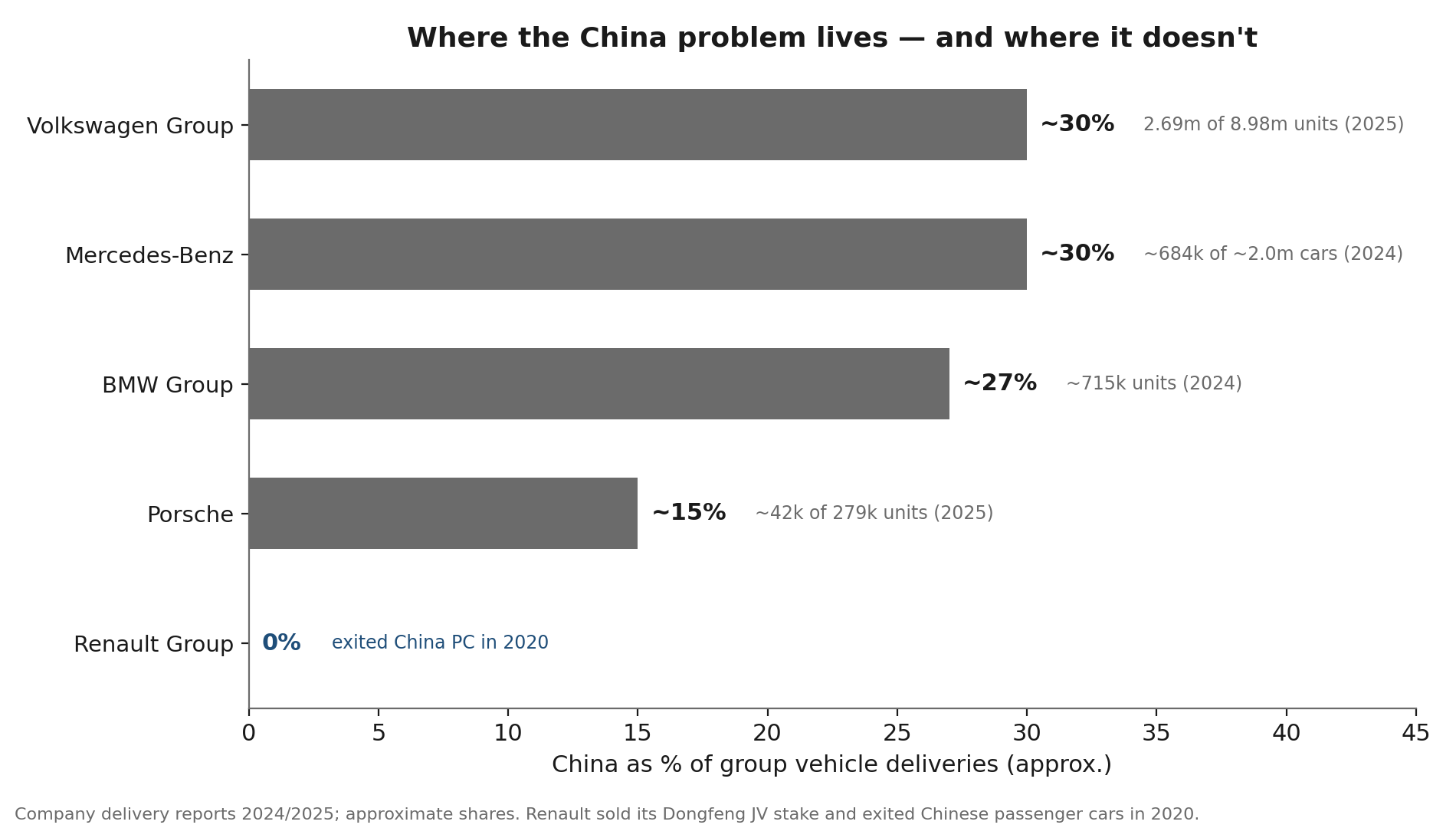
This is the point the bear case consistently misses. “European legacy autos are dying” conflates two completely different diseases, and Renault has neither.
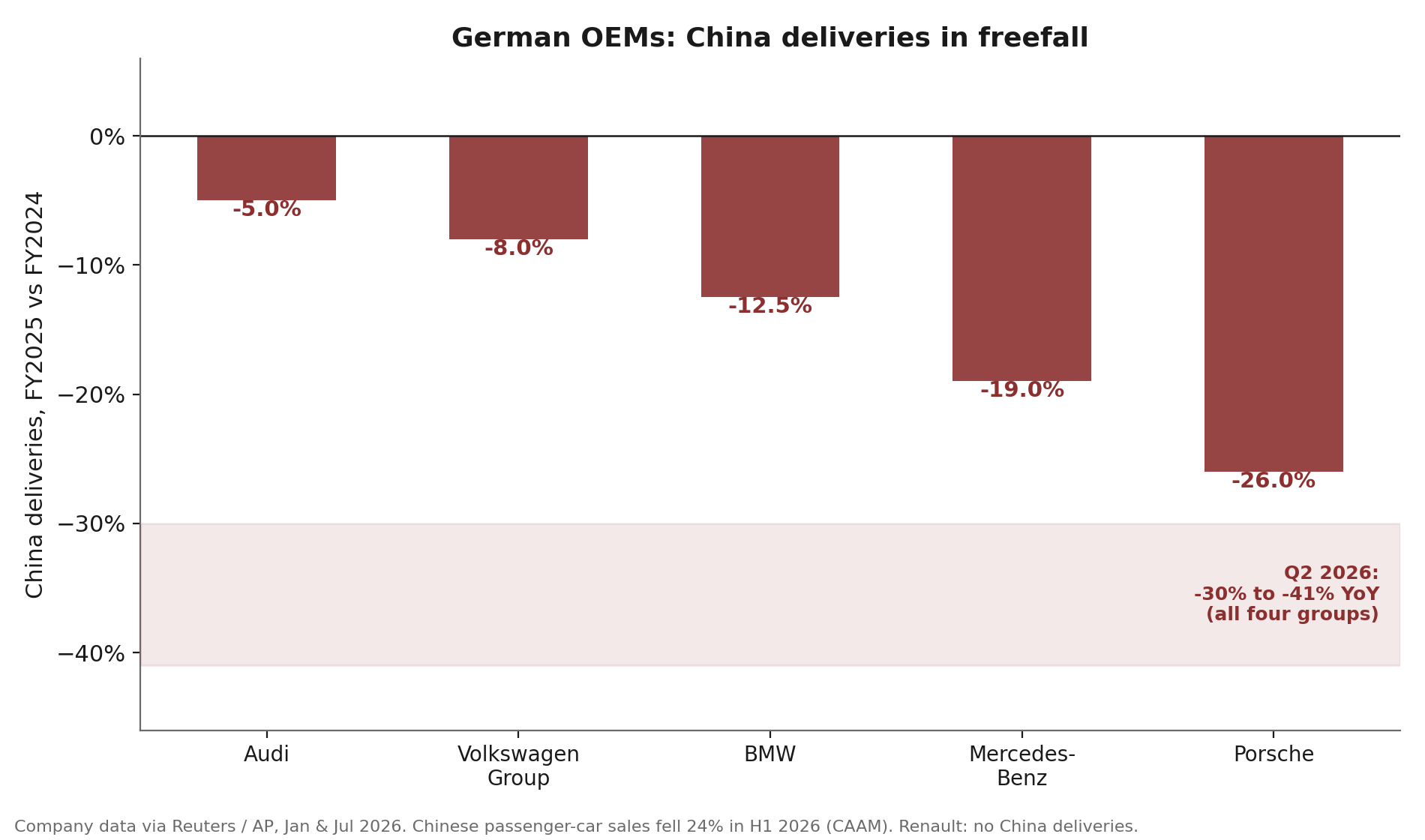
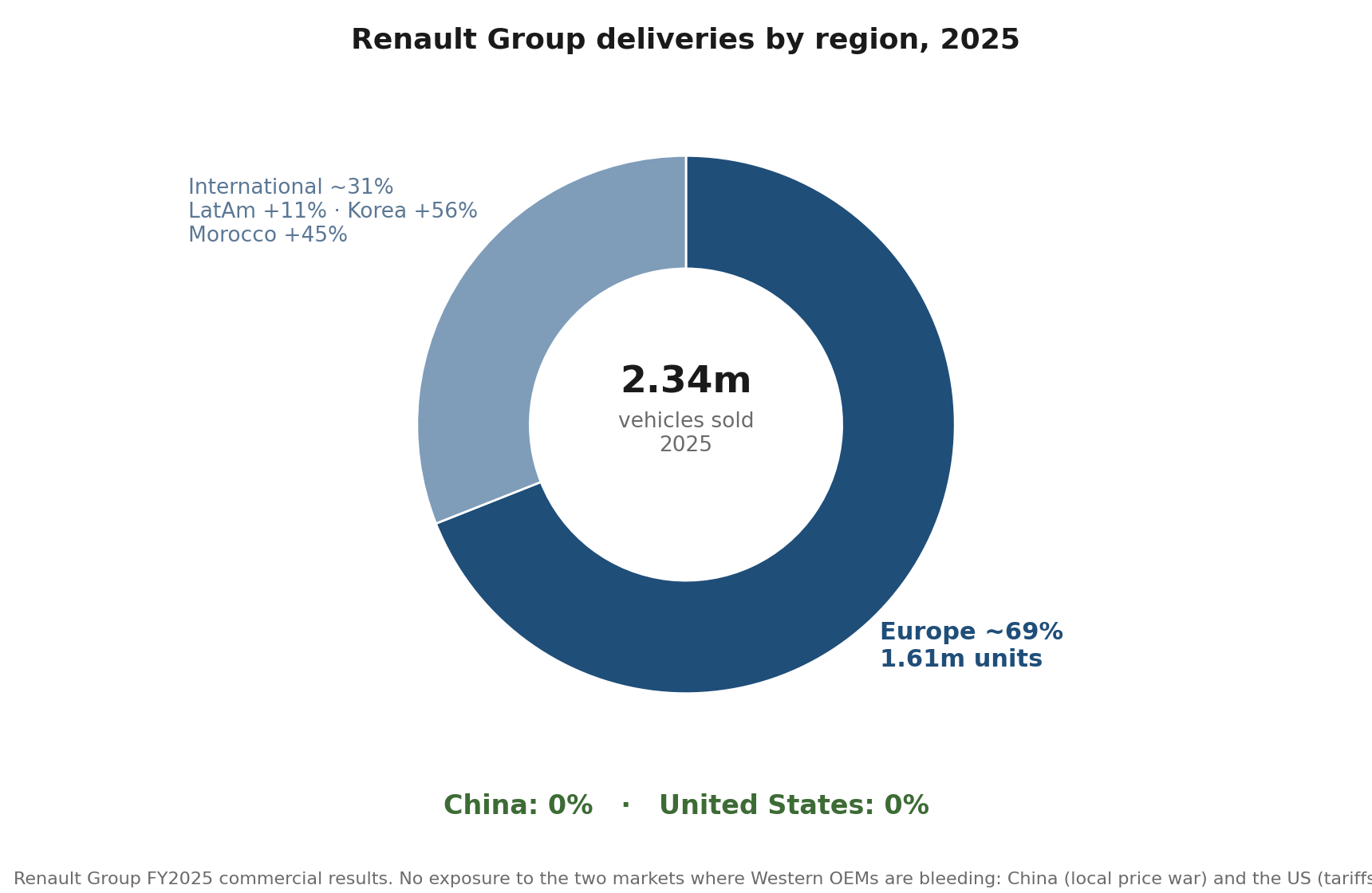
Disease one: China. The German OEMs built their profit pools on China, and those pools are draining. In FY2025, China deliveries fell 5% at Audi, 8% at Volkswagen Group, 12.5% at BMW, 19% at Mercedes and 26% at Porsche. Then it got worse: in Q2 2026, China deliveries at VW, Mercedes, BMW and Porsche collapsed between 30% and 41% year on year, in a Chinese passenger-car market down 24% in H1. VW — China’s #1 carmaker for a quarter of a century — has been overtaken by BYD and then Geely, its share down from ~19% in 2019 to ~14.5%. China was historically around a third of German group deliveries. For Renault it is zero: the group exited Chinese passenger cars in 2020, taking the write-off when it was cheap to do so.
Disease two: US tariffs. The 2025–26 tariff regime hits tens of billions of euros of EU auto exports, most of it German. Audi and Porsche have no US plants and absorb it fully. Renault’s US exposure: zero.
Renault sells ~69% of its volumes in Europe, where it is a top-3 group, the Clio was the best-selling car in the region in Q1 2026, and retail customers — the highest-quality channel — take roughly 60% of its European passenger-car sales, about 17 points above the market average. The remaining ~31% is Latin America, Korea, Morocco, India, Turkey: markets growing double digits for the group (LatAm +11%, Korea +56%, Morocco +45% in 2025) and structurally hybrid/ICE-heavy, where Chinese EV cost advantages bite least.
Pillar 2: the Chinese landing in Europe will be slower and costlier than the market assumes
The bear case’s second leg is that what BYD did to VW in China is about to happen in Europe. Fine — but selling cars is not selling phones. It requires physical delivery, financing, and above all after-sales: nobody spends €30,000 with a brand that cannot fix a battery cell within 50km of their home. Distribution and service are the half of the business the “Chinese invasion” narrative never models.
Look at who has actually cracked Europe. MG is the exception that proves the rule: it did not arrive as an unknown Chinese startup — it bought a century-old British badge and with it access to a dealer network now exceeding 800 European sales points. That network, not the product, is why the MG4 sold. BYD is attacking the same problem with chequebook urgency — signing up large European dealer groups, building its Hungarian plant with another planned in Turkey — and Chery is starting with knock-down kit assembly in Barcelona’s old Nissan factory. All of this is real. All of it takes years, not quarters.
And when they do manufacture here, the economics shift underneath them. The tariff wall — up to ~35–40% on China-built EVs — forces European production at European labor, energy and compliance costs, with processed battery materials still imported from Asia and EU state-aid rules prohibiting the subsidies that built their cost edge at home. The structural advantage largely dissolves at the border. What crosses intact is capital and patience — which buys them a long war of attrition in the B-segment, not a blitzkrieg.
None of this means the threat is fake. Chinese brands already hold over 10% share in several European markets and ~14% of the European BEV segment, and my base case assumes permanent price pressure in small cars. The point is the timeline and the terrain: the market is pricing a 2026 rout, when what is coming is a 2028-and-beyond grind, fought on Renault’s home turf, against a hyper-local dealer and workshop density that took decades to build, in the segments — small cars, vans, hybrids — where the attackers’ one weapon matters least.
Pillar 3: Horse Powertrain — the ICE tail, carved out, marked by a third party, and missing from every screen
In May 2024 Renault and Geely folded their entire combustion and hybrid powertrain operations into a 50/50 JV: Horse Powertrain, headquartered in London — 17 plants, 5 R&D centres on 3 continents, ~19,000 employees, capacity for ~5 million powertrain units a year, supplying engines, hybrid systems and transmissions to Renault, Dacia, Volvo, Nissan, Proton and others. In December 2024, Saudi Aramco bought 10% (in equal parts from each partner) at a €7.4bn enterprise valuation, leaving Renault and Geely with 45% each.
Why this matters more than its line-item value:
-
A third-party mark, not my estimate. Aramco — a strategic buyer with every incentive to negotiate hard — put real money in at €7.4bn. Renault’s 45% is worth ~€3.3bn at that mark; I carry it at €2.5bn after a 25% minority/illiquidity discount. That is a third of Renault’s entire market cap, in an asset most models simply omit because it was deconsolidated from revenue in mid-2024.
-
It converts the “melting ICE ice cube” into a cash-generating tail. The bear case says combustion R&D is dead capital. Renault no longer funds it alone: the JV mutualises development costs across two global groups, and every third-party engine sold (Volvo, Nissan, Horse’s ambition as a consolidated Tier-1 supplier to any OEM that stops making its own engines) turns a stranded-asset narrative into an annuity. Combustion and hybrids will dominate ex-Europe/ex-China volumes for decades — exactly the markets Renault’s international plan targets.
-
Optionality with a decarbonisation kicker. Aramco’s role is not passive capital: the JV is the vehicle for synthetic and low-carbon fuel powertrains. If e-fuels earn any regulatory lane in the 2030s, Horse is one of the best-positioned assets in the industry, and a future listing or further stake sales give Renault a clean monetisation path.
The Geely relationship extends beyond Horse. Geely owns 34% of Renault Korea, whose Geely-platform Grand Koleos drove Korean volumes up 56% in 2025 — a live demonstration that Renault can plug partner platforms into its industrial footprint and grow with someone else’s capex.
Pillar 4: the Alliance stopped being a soap opera and started paying rent
The restructured Alliance — both sides at 15% with full voting rights, cooperation reduced to specific projects with a business case — has quietly flipped from governance drama into a set of cash-generating and option-generating contracts.
Solid-state batteries: a free call option. Under the Alliance’s leader–follower split, Nissan leads next-generation battery development for the group while Renault leads software and vehicle architecture. Nissan is among the furthest along of any legacy OEM on all-solid-state batteries: in April 2026 it confirmed 23-layer prototype cells validated at its Yokohama pilot line, on a roadmap to commercial production in 2028 — targeting roughly double the energy density of today’s packs, charging times cut to a third, and costs around $65/kWh, which is genuine price parity with combustion. If that lands, Renault accesses the technology without having paid the solo R&D bill. Every bear model assumes Renault fights the 2030s with the same lithium-ion chemistry as everyone else, paying Europe’s energy prices; this option is carried by the market at exactly zero.
Ampere as Nissan’s European manufacturer. Nissan has concluded that Renault’s EV unit engineers small European EVs better and cheaper than it can itself: Ampere will develop and build Nissan’s compact EV in France, plus an A-segment model derived from the new Twingo from 2026. Contract revenue — and, more importantly, volume that fills the very French plants Renault is politically unable to close, diluting the fixed costs the state forces it to carry. A structural liability converted into paying work.
Scale where nobody looks. Shared platforms mean a Nissan Qashqai and a Renault Austral are structurally the same car, giving joint purchasing volumes neither could command alone. Renault builds vans sold under Nissan’s badge and books the industrial profit. And in many markets Nissan’s European sales are financed through Mobilize — Renault collects a financing margin on its partner’s cars.
The second act: an international plan the screens haven’t priced
In 2025 Renault bought Nissan out of their shared Chennai plant, taking 100% control of its Indian industrial base. Around that sits the international plan: roughly €3bn to launch 8 models outside Europe by 2027 on a new modular platform engineered for emerging markets — combustion, hybrid, flex-fuel, 4x4: the technologies those markets actually buy — with India doubling as a low-cost export hub targeting ~€2bn a year of exports by 2030, and a stated goal of doubling net revenue per vehicle sold outside Europe versus 2019. The Kardian, built in Brazil and Morocco, is the first proof point.
This is not a moonshot; it is the same playbook that already works — hybrid/ICE product from cost-advantaged plants, sold into markets growing double digits for the group, where Chinese EV economics travel worst. Execution risk is real: India is a knife-fight refereed by Maruti-Suzuki’s and Hyundai’s cost structures, LatAm operating wins have historically been eaten by currency depreciation, and BYD is building in Brazil too. Which is exactly why my SOTP assigns this plan no credit at all. It is a free second act on top of a valuation that already works without it.
The operating reality the price ignores
- FY2025: revenue €57.9bn (+3.0%), operating margin 6.3% (€3.6bn), automotive FCF €1.47bn, net cash up to €7.37bn. Guidance delivered.
- Q1 2026: revenue +7.3% to €12.5bn; automotive +6.5%; Mobilize +13%. LCV back to growth, +15% in Europe.
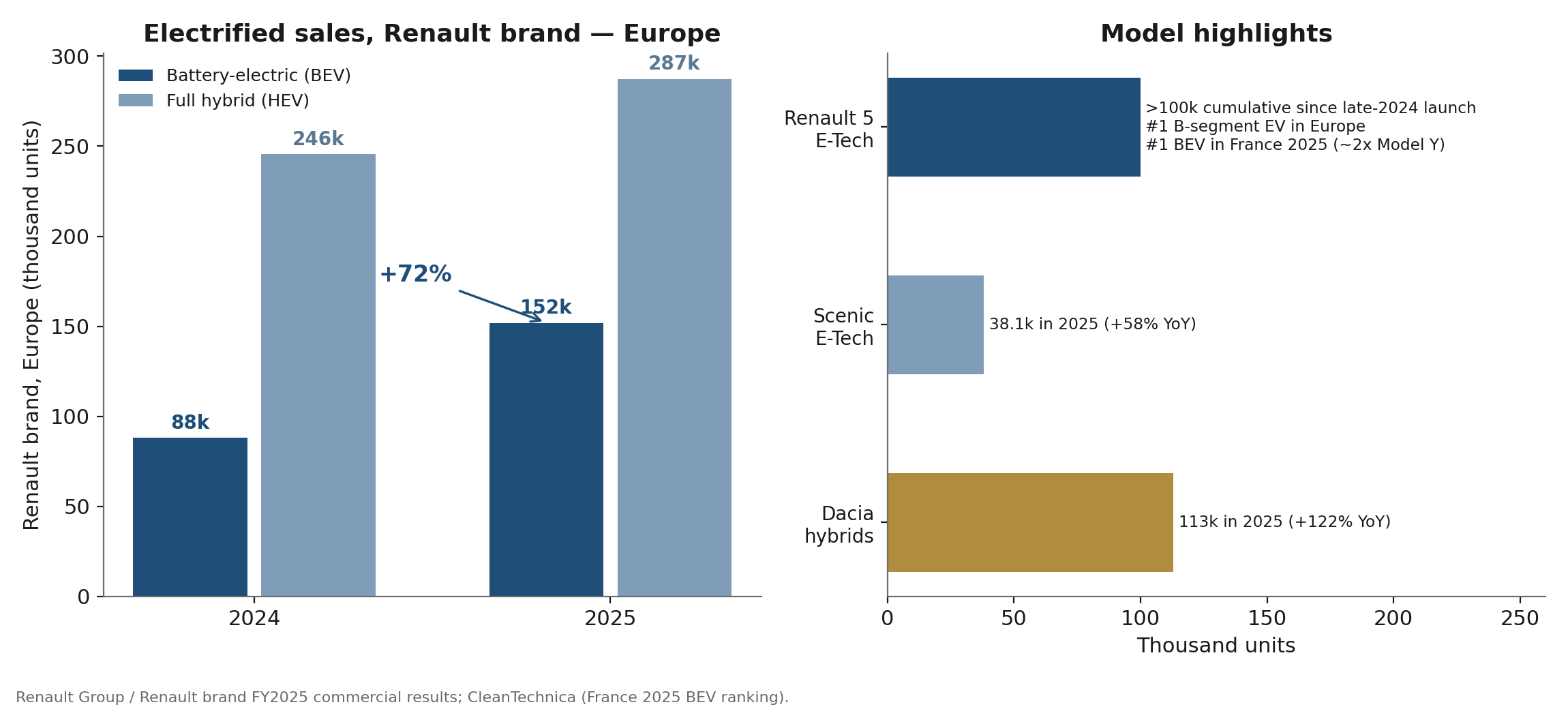
- Product execution: Renault 5 E-Tech past 100k cumulative units, #1 B-segment EV in Europe and France’s best-selling BEV in 2025 at roughly twice the runner-up (Model Y). Brand EV sales +72% in Europe in 2025 (152k units, 20% of PC mix); +40% again in Q1 2026. Full hybrids ~38–40% of brand PC sales. Dacia hybrids +122%. Twingo E-Tech under €20k now launching — the direct answer to Chinese A-segment EVs.
- Software: Ampere ships Android Automotive with Qualcomm silicon — best-in-class infotainment without the multi-billion in-house OS bonfire that burned VW.
- Shareholder returns: forward dividend €2.20, an 8.4% yield at the current price. You are paid handsomely to wait.
Risks, honestly weighted
- Margin compression is real and guided. 2026 guidance is ~5.5% group margin and ~€1.0bn automotive FCF — down year on year on EV mix dilution, India consolidation and European price pressure. My SOTP uses 5% for Renault PC precisely so that guided softness is already in the number.
- Chinese entrants in Europe (Pillar 2): the base case must assume permanent margin pressure in the B-segment. Dacia’s cost position and retail channel are the shield; they are not impenetrable. By 2027–28 the Hungarian and Turkish plants will be running.
- The French state holds 15% of capital and ~30% of votes (double voting rights). It blocks plant closures, colours capital allocation, and reportedly vetoed a BYD approach in July 2026. This is the single best reason the discount never fully closes — it is why I apply 20% at the conglomerate level and why my target is €23–26bn and not €31bn.
- Nissan remains fragile; the trust shares are a slow exit at depressed prices. I carry the stake at market less 25%. The solid-state program is optionality, not a promise — if it slips past 2028, nothing in my valuation changes, but nothing improves either.
- International execution. India punishes anyone who cannot match Maruti-Suzuki on cost, and LatAm brings FX volatility that has historically eaten operating gains in translation. ~€3bn is committed to a plan my valuation gives no credit for — the risk is mediocre returns on that capital, not a broken thesis.
- LCV cyclicality: 2025 showed how fast the van market can turn (-16.5% for the brand). Recovery is underway but the segment is not immune.
What has to be true for this to lose money
At €7.5bn, the industrial business is priced below zero. A permanent loss of capital from here requires Dacia, the van business and the Renault brand to jointly burn through the excess cash, force distressed sales of the Nissan and Horse stakes, and impair the finance arm — a multi-year, simultaneous failure across every division, starting from record net cash, positive FCF and growing revenue. Everything short of that scenario ranges from acceptable to spectacular. That asymmetry, not any heroic growth assumption, is the thesis.
Catalysts
- Continued trust-share disposals in Nissan converting a discounted paper asset into cash.
- Horse Powertrain monetisation events: further stake sales, third-party OEM contracts, an eventual listing.
- Nissan’s solid-state milestones on the road to 2028 production — each one reprices an option the market carries at zero.
- Capital returns: an 8.4% dividend yield with net cash rising; any buyback at these levels is massively accretive per the SOTP.
- Twingo E-Tech ramp and the 2026–27 product wave defending the B-segment.
- Delivery of the international plan: Kardian volumes and Indian exports ramping toward the €2bn target.
- Each quarter of delivered FCF guidance shrinking the “value trap” narrative.