
AIM · Security technology
Spectra Systems: the toll booth on the world's banknotes, with the options thrown in free
Authentication and anti-counterfeiting: normalised earnings, cash conversion and new applications that still need to become contracts.
Share price
Since purchase
Price in local currency, excluding dividends. Latest available quote; may be delayed.
The thesis in three points
- Opportunity
- An authentication business with existing revenue and potential new applications.
- Key assumption
- Normalised earnings exclude contract peaks; new applications require awards and execution.
- What to monitor
- Sensor collections, Cartor working capital, customer concentration and signed contracts versus expectations.
Valuation and prices refer to the original analysis date. Subsequent updates are identified separately.
In this analysis
Published July 2026. Market cap ~£90m (~$120m; ~48.3m shares at 186p, 52-week range 112-230p). Reports in USD, quoted in GBp. All reasoning in market cap and enterprise value.
The one-paragraph version
Spectra sells the invisible chemistry inside banknotes and the high-speed sensors central banks use to read it. Twenty central banks, including two G7 issuers, are locked into its technology through switching costs measured in decades. The business runs on intellect rather than capital, converts extraordinary gross margins into cash, pays a rising dividend, and is still run by the physicist who founded it in 1996 with ~8% of the shares. 2025 was the most profitable year in its history — revenue $64.3m (+31%), adjusted pre-tax profit $25.2m (+109%), adjusted EPS doubled to 37.8¢. Against that, ~£90m of market cap buys the recurring core at roughly 10x normalized earnings with a 5.5% dividend, and assigns zero value to three live, government-scale options: the Fusion polymer substrate (Middle East qualification expected this year, an Asian central bank already requesting pricing), the tax-stamp franchise, and smartphone authentication. Heads I win; tails, the toll booth keeps collecting.
What the business actually is

Founded in 1996 out of Brown University by Dr. Nabil Lawandy — still CEO thirty years later — Spectra operates four connected lines:
Banknote authentication (the crown jewel). The razor-and-blades model in its purest institutional form. Spectra sells central banks the high-speed sensors installed in their note-sorting machines (the razor), then supplies, year after year, the covert taggant materials and inks embedded in every new banknote for those sensors to validate (the blades). Once a central bank designs Spectra’s chemistry into its currency, replacing it means redesigning the security of the national money supply and re-equipping every cash centre in the country. Contracts run 5-10 years; the relationships run far longer. Twenty central banks, two of them G7.
Optical materials. Fluorescent, phosphorescent and gasochromic pigments for documents and brand protection — physically tiny volumes at extraordinary value density.
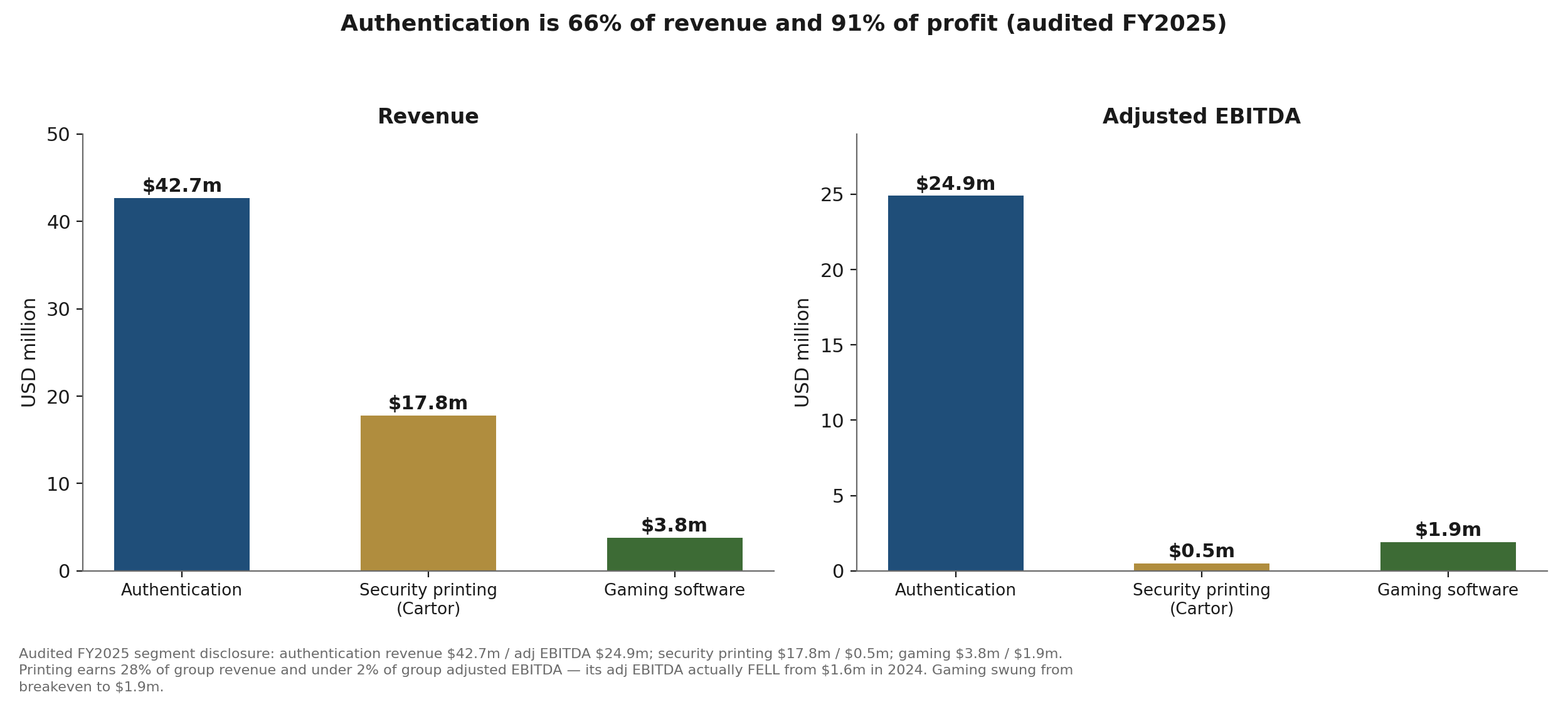
Gaming security software (Secure Transactions). Internal-control systems certifying that US state lotteries and gaming operators aren’t manipulated. Pure software economics, and 2025 was a genuine turnaround: revenue $3.8m (from $2.0m) and adjusted EBITDA $1.9m against breakeven the year before.
Security printing (Cartor). The 2023 acquisition, covered below — high-security stamps, postal issues and, critically, the route to market for polymer banknote substrate.
Why this niche is a fortress
This is one of the lowest-turnover industries on earth. The customers are the most conservative buyers imaginable: nobody at a central bank gets fired for keeping the system that works. Suppliers change only after a catastrophic security failure, a forced technology leap (paper to polymer), or when the incumbent’s finances scare the customer. The competitive set is a museum of longevity — De La Rue (1821), Crane Currency (1801), SICPA (1927). Spectra, at thirty, is the young one, and it competes as a sniper rather than a factory: it sells the brain of the banknote (sensors, taggants, substrate chemistry — high margin, low capital) instead of the body (commodity printing — high capex, thin margin).
The De La Rue contrast is increasingly commercial. The world’s largest commercial banknote printer has spent years lurching between profit warnings, debt and restructurings — and financially stressed suppliers terrify sovereign customers who need decade-long continuity. Spectra’s clean balance sheet is itself a sales argument, and central banks sometimes mandate Spectra’s technology inside notes that incumbents print. The barrier here is not money; it is trust plus patented materials science, accumulated over decades.
One structural point the screen never shows: this is an R&D-intensive, capex-light business. The war against state-sponsored counterfeiters is won in the laboratory, not the machine hall. Value lives in patents and secret formulations. Historic capex ran at 1-5% of revenue; even after adding Cartor’s presses, the group remains asset-light by any industrial standard — FY2025 capex was $186k on $64m of revenue.
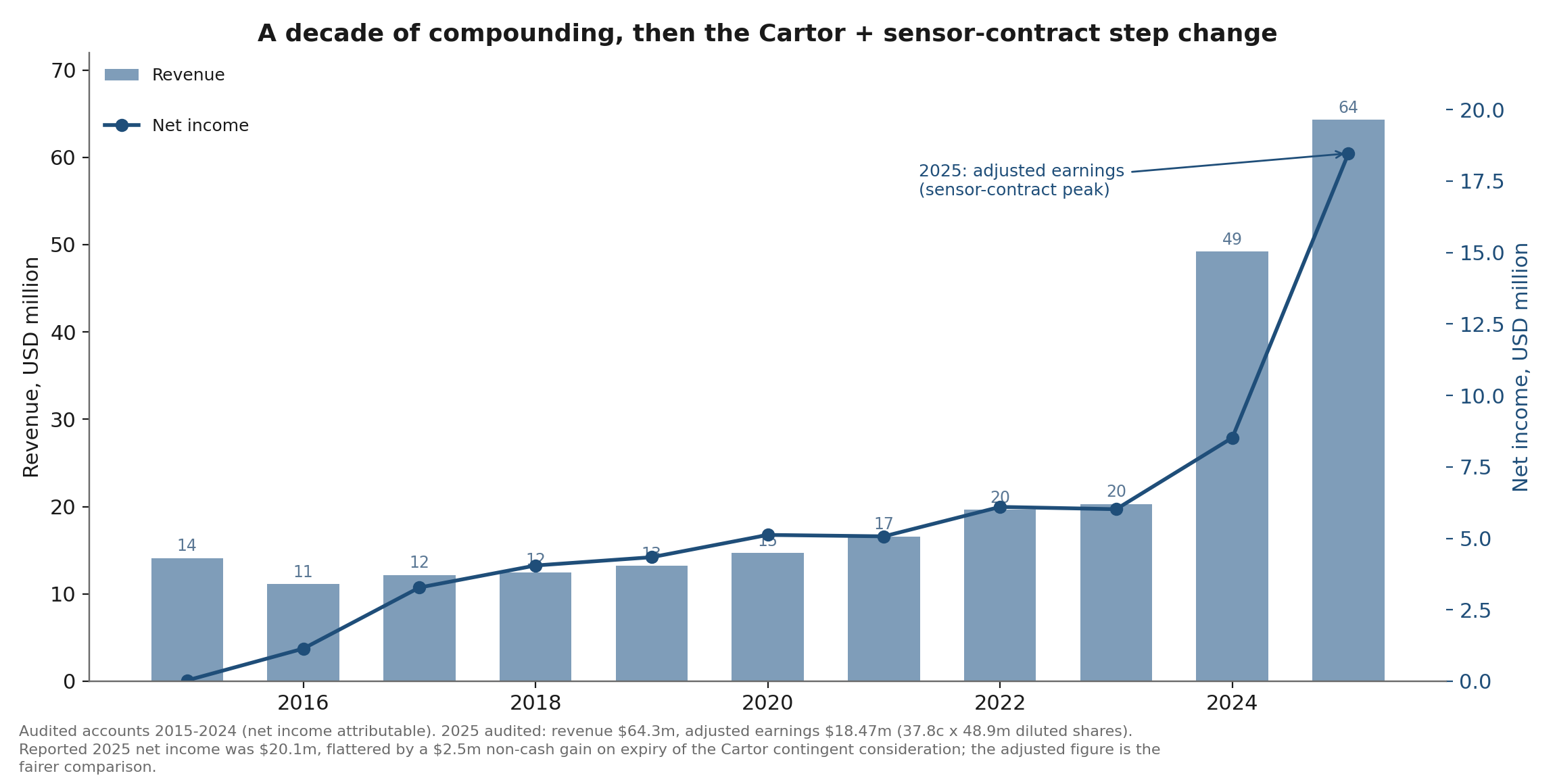
Ten years of audited accounts tell the story: revenue from $14m to $64m, net income from breakeven to $18.5m adjusted, fat net margins throughout, dividends every year, and a share count that only moved from ~45m to ~48.3m — essentially all of it equity consideration for Cartor, not financing dilution.
Cartor: buying the body to sell more brains
In December 2023 Spectra acquired Cartor Security Printers (~$6.2m net cash outlay plus ~$4.1m in shares and ~$3.8m contingent consideration) — UK and French plants printing postal stamps, tax stamps and secure documents. On a standalone basis it is a step down in quality, and the audited FY2025 numbers say so plainly: $17.8m of revenue but only $0.5m of adjusted EBITDA, down from $1.6m in 2024. The market read the deal as dilution of a beautiful business, and on segment economics alone it has been right so far.
That reading still misses what Cartor is for. Three things:
-
Prime-contractor status. Governments award security-printing contracts to printers, not to materials houses. Without Cartor, Spectra could only ever be a component supplier inside someone else’s bid. With Cartor, it leads consortia. The proof arrived within two years: Cartor is the prime on the HMRC vaping duty stamps contract — £32m ($43.8m) over five years plus a one-year option, won with SICPA, with Spectra invoicing the full amount and keeping roughly 22% of the economics plus the strategic position. The contract was consummated in 2026; phased rollout runs from a transitional stamp in April 2026 to full track-and-trace from October 2026. A 30-person Rhode Island lab does not win an HMRC procurement; a UK security printer with American physics inside does.
-
The Fusion route to market. Central banks buy polymer substrate as print-ready sheets to their specifications, and producing them requires exactly the industrial capability Cartor provides. Brazil’s government printing house, Casa da Moeda, produced a polymer house note using Spectra’s substrate with embedded covert machine readability. Fusion is now qualified with two major private banknote printers and one government printworks. No Cartor, no credible Fusion offer.
-
Fixed-cost defrayal with contracted revenue. The restructuring refocuses printing on multi-year postal and tax-stamp contracts. Seventeen staff have gone at Wolverhampton, three of them management, and a new $4m four-year hybrid-stamp contract was won in 2025 — recurring, technology-differentiated, margin-bearing.
But be clear about where this stands: the printing turnaround has not happened yet, and the timetable has slipped. The French closure has been pushed to the end of Q3 2026 on French legal requirements and complications transferring Royal Mail production equipment to the UK. More importantly, management states outright that the plan for printing profits in 2026 depends on allocating gravure machine labour costs across other contracts — and that the most critical of those is the Royal Mail renewal, which is still unsigned. The tender went out in early 2025 with an award expected that June; EP Group’s takeover of Royal Mail’s parent intervened, previous delivery practices were suspended, and there is still no executed contract. Royal Mail keeps placing individual orders in line with what the contract would have covered, and Spectra says it is highly confident of the award. Confident is not signed. This is the single loosest brick in the thesis.
The sensor contract: record earnings, and the cash still to come
The engine of the 2024-2026 numbers is a comprehensive contract with a major world central bank: $14.8m of development funding plus a $39.6m sensor-manufacturing order. In 2025 this produced $22.0m of sensor production revenue plus $7.3m of related hardware sales, and it is scheduled for completion in 2026.
Percentage-of-completion accounting recognises that revenue as work is performed, ahead of billing — which is why the audited accounts show a $10m gap between reported net income and cash:
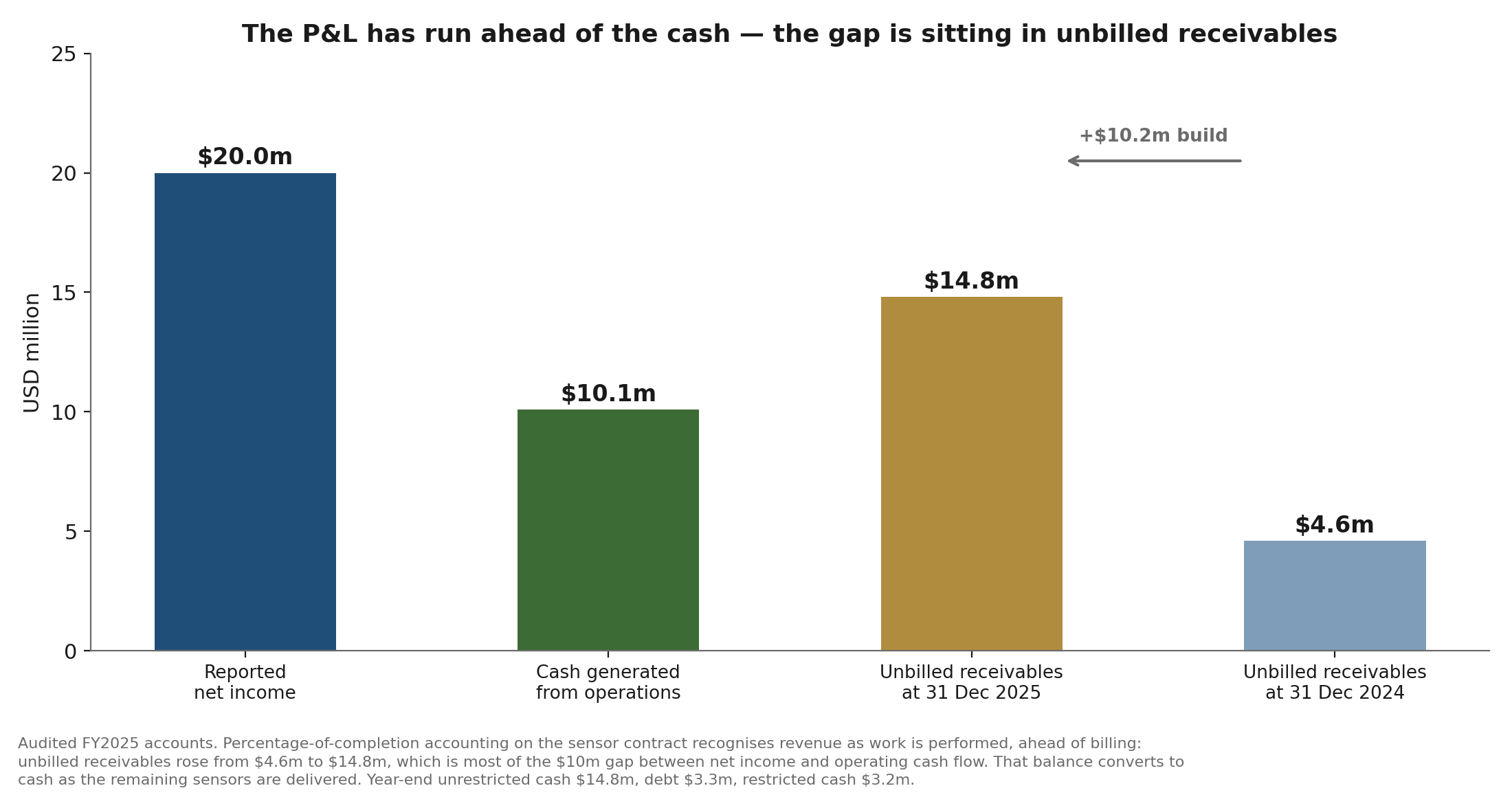
Net income was $20.0m; cash generated from operations was $10.1m. The difference is mostly a $10.2m build in unbilled receivables, which ended the year at $14.8m against $4.6m twelve months earlier. That balance is money earned and owed, converting to cash as the remaining sensors ship in 2026. The first deliveries in December 2025 triggered a $5.7m payment, and — the underrated part — a maintenance contract worth ~$6.7m from 2026 to 2030: the blades that follow the razor, again.
Two caveats worth stating. Reported net income of $20.1m attributable was flattered by a $2.5m non-cash gain on the expiry of the Cartor contingent consideration; adjusted earnings of $18.5m is the fairer number. And “the cash arrives in 2026” is management’s schedule, not a fact yet on the balance sheet — year-end unrestricted cash was $14.8m against $3.3m of debt, plus $3.2m restricted. The cash-to-debt ratio of 4.5x is comfortable; the large cash pile is still a forecast.
FY2025: the most profitable year in company history
- Revenue $64.3m, +30.7%
- Adjusted pre-tax profit $25.2m, +109%
- Adjusted EPS 37.8¢ vs 18.9¢ — doubled
- Gaming: revenue $3.8m and adjusted EBITDA $1.9m, from breakeven
- Dividend raised 17% to $0.136, payable 17 July 2026; debt down 25%
- Cartor won the $4m hybrid-stamps contract; smartphone print trials with a Middle Eastern police authority succeeded
The optionality stack — all of it priced at zero
Fusion polymer substrate. The world is migrating from cotton paper to polymer notes, a market dominated in near-monopoly by CCL Secure’s Guardian. Fusion is the credible challenger with two genuine differentiators: a level III covert security feature embedded during the BOPP extrusion itself (protecting against counterfeiters who can buy commercial film), and the industry’s first certified-circular sustainable polymer — which resonates with exactly the institutions that issue currency. The commercial state of play, from the FY2025 statement: Spectra spent an extra $265k in 2025 on substrate requirements specific to a Middle Eastern central bank, and expects full qualification plus a small first test order in 2026. An Asian central bank has begun the second phase of qualification and requested pricing, for Fusion with machine-readable capability plus sensors. Two further central banks, one Asian and one South American, have requested sample substrates for evaluation. That is four sovereign conversations running at once, from one qualification — which is precisely how this industry compounds. Winning even a modest share of polymer tenders over the coming decade would make today’s revenue base look small; the market prices this at zero.
The tax-stamp franchise. The HMRC vape contract is the beachhead, not the prize. Every government taxing vapes, tobacco or alcohol needs stamps that can’t be forged, and Spectra’s smartphone technology lets an inspector or consumer verify a stamp with a phone instead of thousand-dollar hardware. Management describes an opportunity for materials and smartphone authentication across several billion tax stamps per annum, with hybrid stamp adoption spreading through the EU, and successful 2025 print trials with the authority issuing driving licences and secure documents in a major Middle Eastern country.
Passports and documents. Covert features validated with the two largest suppliers of forensic passport-control equipment, trials underway with a major security-paper supplier. Individually small; collectively they extend banknote-grade chemistry into adjacent sovereign niches with the same buyer psychology.
Valuation: what you pay and what you get
At 186p the market cap is ~£90m (~$120m), against a 52-week range of 112-230p. Here is what that buys.
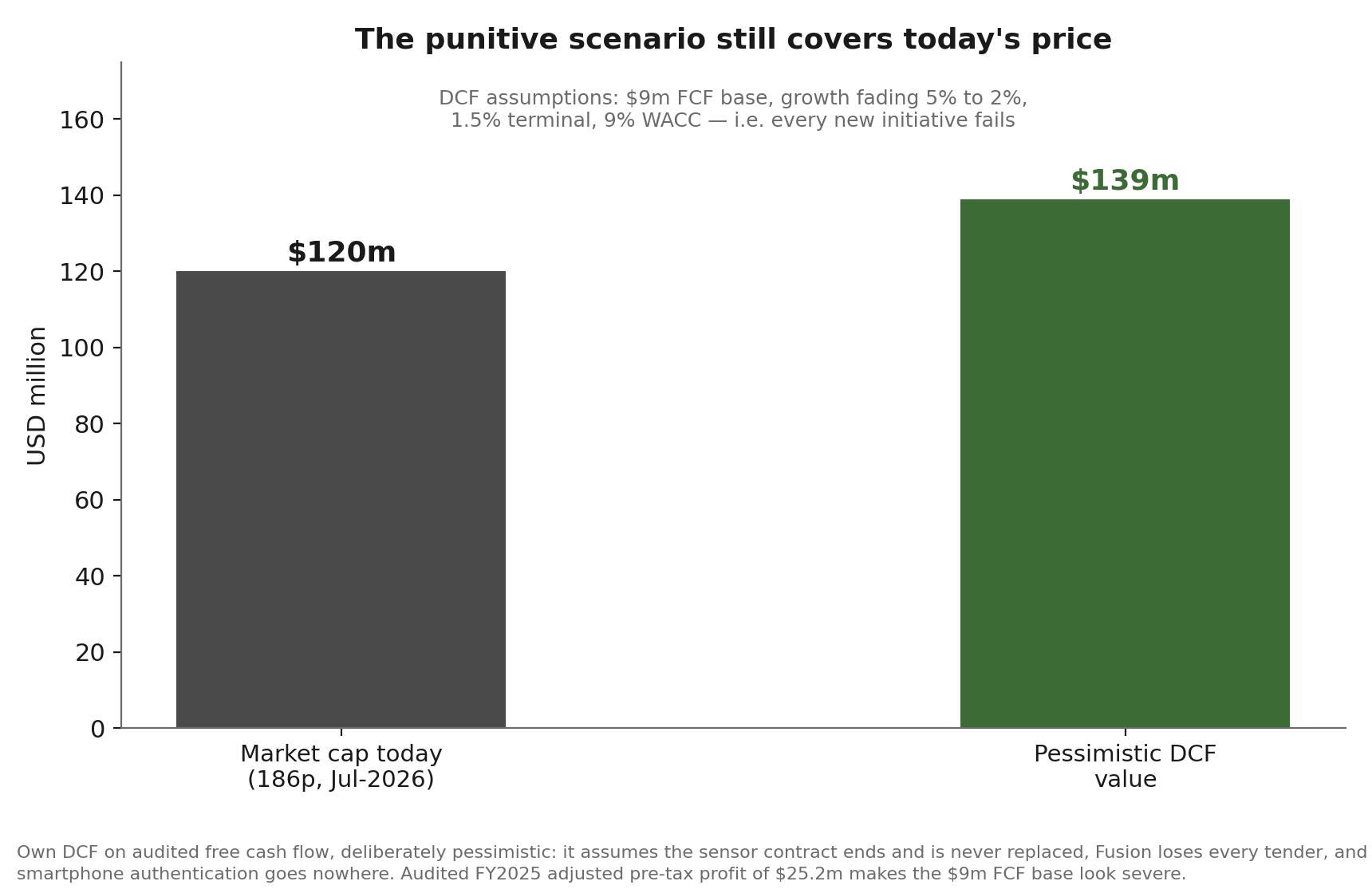
The pessimistic anchor: a deliberately punitive DCF — $9m FCF base (below the pre-contract trajectory plus contracted additions), growth fading from 5% to 2%, terminal growth 1.5% (below inflation forever), 9% WACC — produces ~$139m of equity value. That is the scenario in which the sensor contract ends and is never replaced, Fusion loses every tender, smartphone goes nowhere, and Spectra just keeps collecting tolls. It covers today’s entire market cap.
The normalization: strip the sensor-contract peak entirely and rebuild post-2026 earnings from disclosed pieces — the $6.0m pre-contract 2023 net income base, the gaming step-change, the $6.7m maintenance annuity, Spectra’s ~22% of the vaping contract through a restructured Cartor, and optical materials growth:
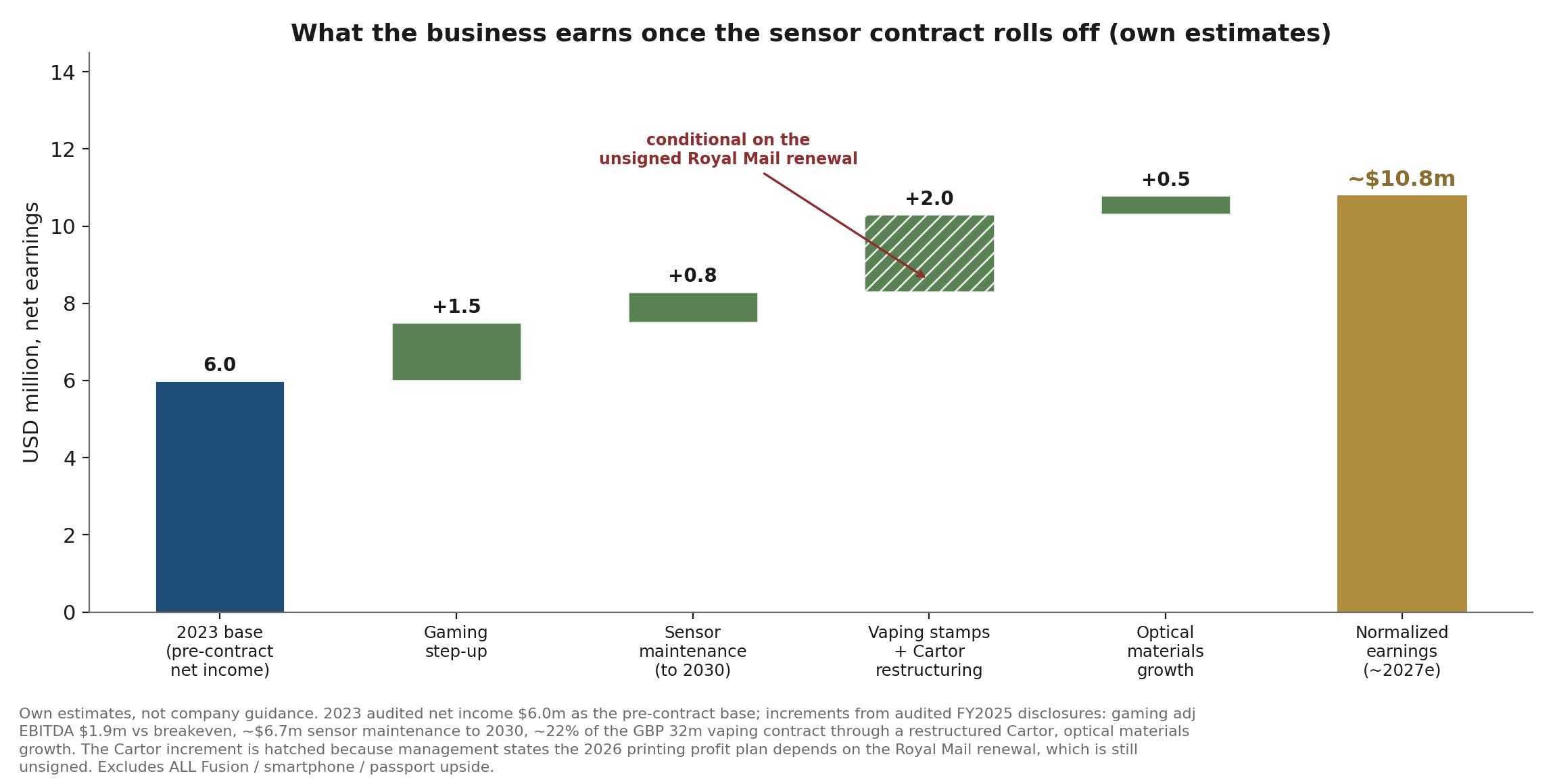
Call it $10-12m of normalized net earnings. Against ~$120m of market cap less ~$11.6m of net cash, the enterprise trades around 10x normalized earnings — for a founder-led oligopolist with sovereign switching costs, net cash, a 5.5% dividend and every option above included at nil. Note the Cartor increment in that bridge is the conditional one: it assumes the printing restructuring lands and Royal Mail renews. Strip it out entirely and normalized earnings are ~$8.8m, or roughly 12x — still not demanding, and still with the options free.
The trailing adjusted P/E of ~6.6x overstates the cheapness, because 2025 was a contract peak that does not repeat. The forward consensus P/E overstates the expensiveness, because it normalizes earnings while ignoring the cash and pricing no options. The truth in between: fair-to-cheap for the core, free lottery tickets stapled on.
Skin in the game. Insiders hold ~19%; Lawandy personally holds ~8.1% (~3.9m shares), has run the company since 1996, has never used the share count as a financing tool, and takes the same dividend every shareholder gets. Institutions (Raymond James ~10.5%, Charles Stanley, Sandon Capital’s Mercantile) hold ~40%+. This is the Buffett configuration: founder-owner, closed niche, net cash, rising payout.
Risks, honestly weighted
- Customer concentration. One central bank drives the current revenue and cash wave. The maintenance contract and the relationship mitigate; they do not eliminate.
- The Royal Mail contract is unsigned. Management’s own 2026 printing profit plan depends on it, and it has been pending since a June 2025 award date passed. Business continues on individual orders, but until it is executed, the Cartor half of the normalization is a hope.
- The 2027 optics cliff. When the sensor contract completes, reported revenue and earnings will fall sharply against 2025-26 comparables. A market that didn’t understand the accounting on the way up may not understand it on the way down. This is simultaneously the main derating risk and the most likely source of the next attractive entry.
- Cartor is not yet fixed. FY2025 adjusted EBITDA of $0.5m was below 2024’s $1.6m, and the French closure has slipped to Q3 2026. Management guides to profits in 2026 — hold them to it.
- Fusion is binary per tender. CCL Secure is a formidable incumbent, central banks are slow, and timelines have slipped before. The thesis survives Fusion failing entirely; the multibagger case does not.
- The cash is contracted, not banked. Operating cash flow was $10.1m against $20.0m of net income; the conversion depends on delivering the remaining sensors on schedule.
- AIM microcap frictions. Thin volume, wide spreads, and a governance flag worth watching: reports of a stalled AGM raised concerns during 2025. USD results with a GBp quote add currency noise.
What has to be true for this to lose money
A permanent capital loss from ~£90m requires the recurring toll booth — twenty central banks’ worth of consumables, service and software — to erode materially, Cartor’s restructuring to fail, the contracted sensor cash to somehow not translate into value, and every optionality to expire worthless, all at once, in a business with net cash, a covering dividend, and a founder holding 8% who has protected per-share value for thirty years. Available evidence points the other way on each count. Asymmetry, not forecast, is the thesis.
Catalysts
- Middle East: full Fusion qualification and first test order, expected 2026.
- The Asian central bank’s second-phase qualification and pricing request converting to samples — the second domino.
- Royal Mail contract execution — the cleanest single de-risking event available.
- Sensor cash collection through 2026: unbilled receivables converting, net cash becoming hard to ignore next to the market cap.
- Cartor restructuring completed (French closure, Q3 2026) and vaping stamps going live: transitional April 2026, full track-and-trace October 2026.
- Capital deployment: management is evaluating acquisitions with the incoming cash; buybacks or special dividends at these prices would be equally welcome.