
TSXV · MarTech
Zoomd Technologies: a cash floor, and an unpriced recovery
Available cash and a performance-marketing recovery, weighed against customer concentration and capital allocation risk. Includes a Q2 2026 update.
Share price
Since purchase
Price in local currency, excluding dividends. Latest available quote; may be delayed.
The thesis in three points
- Opportunity
- An operating recovery could increase the business value above its available cash.
- Key assumption
- Cash is preserved and customers generate sustainable margins; cash does not guarantee a share-price floor.
- What to monitor
- Quarterly revenue and margin, concentration, cash after investment and acquisition prices.
Valuation and prices refer to the original analysis date. Subsequent updates are identified separately.
In this analysis
Update · 9 September 2026
The official Q2 2026 results, published on 31 August, report US$7.7M revenue (+11% versus Q1, but −61% year on year) and US$22.6M cash, with no bank debt.
Interpretation: a sequential improvement, still well below activity before the customer adjustment. One quarter does not establish a sustainable recovery. The July analysis and CAD valuation below remain historical; they have not been recalculated using these results and do not represent a current quote.
Published July 2026. Market cap ~C$49m (~100.8m shares near C$0.485). Net cash C$31.7m, no bank debt. Zoomd reports in USD; every figure here is converted to CAD at 1.4105 so the operating numbers and the quote are comparable.
The one-paragraph version
Zoomd runs a performance-marketing platform that acquires paying users for large advertisers, charging on results across 600+ media sources. It is profitable and cash-generative: 2025 produced C$25.2m of operating cash flow and ended the year with C$31.7m of cash and no long-term debt. Then two of its largest customers swapped a piece of measurement software (their MMP) in late 2025 and paused spend during the transition — an event that has happened twice in Zoomd’s history — which halved quarterly revenue (Q4.25 -50%, Q1.26 -62% year on year) and sent the stock down roughly two-thirds. The market now prices near-permanent impairment: against a C$48.9m market cap, C$31.7m of net cash is about 65% of the price, leaving C$17.2m for the entire operating business — less than one times the cash flow that business produced last year. If Zoomd stays stuck, the cash and a still-cash-positive cost structure carry the downside. If any one of several levers works — the recovering customer returning, 2026 World Cup event revenue, the E2 sports-betting partnership, the scaling 2025 client cohort, or tuck-in acquisitions bought for their customer books — you own that recovery without having paid for it.
What Zoomd does
Zoomd, founded in 2012 and listed on the TSXV since 2019, sits one layer above the fragmented digital-advertising ecosystem. Its platform connects to 600-700 media sources — the major ad networks plus the long tail of the open internet — and allocates advertiser budgets to the best-performing channels from a single control centre. The model is performance-based: Zoomd is paid when paying users are acquired, not for impressions. It serves large enterprise clients across 12+ verticals — ecommerce, iGaming, FinTech, entertainment — in 50+ countries, with Shein a cornerstone client historically.
The structural argument, in the founder’s framing, is that in-house media-buying teams have become less effective as privacy changes and rising complexity make the ecosystem harder to navigate. Because Zoomd connects to hundreds of sources rather than depending on one platform, it can keep delivering results where a single-channel in-house team struggles. It builds population-segment profiles rather than storing personal data, which helps in a GDPR world.
The cash-box math
Start with the balance sheet, because it is the whole point.
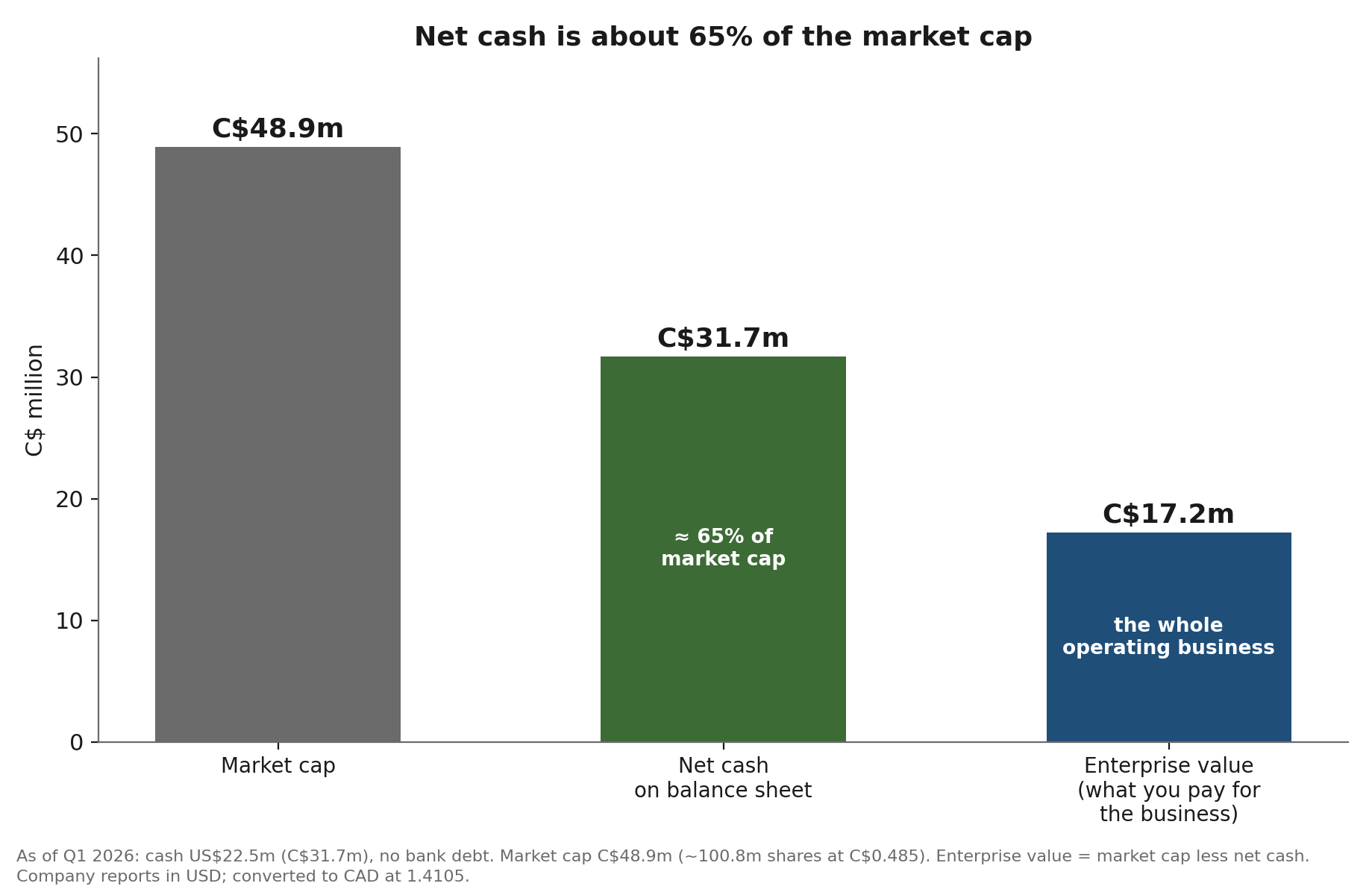
As of Q1 2026, Zoomd held C$31.7m (US$22.5m) of cash and no bank debt, against a market capitalization of about C$48.9m. Net cash is roughly 65% of the market cap, and the enterprise value — what you are actually paying for the operating business — is around C$17.2m. That business generated C$25.2m of operating cash flow in 2025.
The market is valuing the operating business at close to nothing, which is only rational if its earning power is close to permanently impaired. The rest of this thesis is about why that is probably too pessimistic, and why the cash means you are paid to wait while it is tested.
What actually happened: the MMP shock
The revenue collapse has a specific, knowable cause, which Chairman Amit Bohensky has explained on the earnings calls and in interviews.
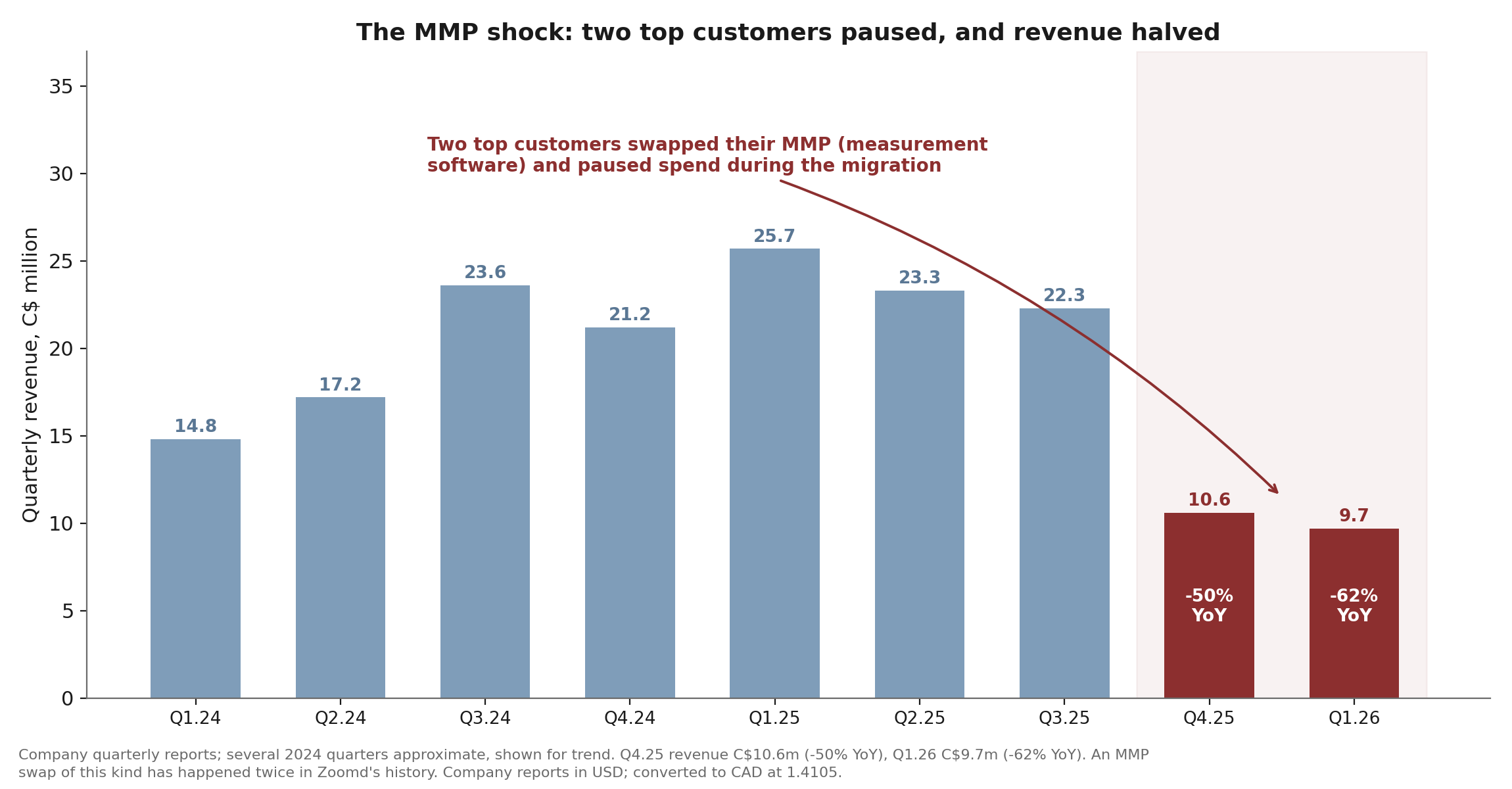
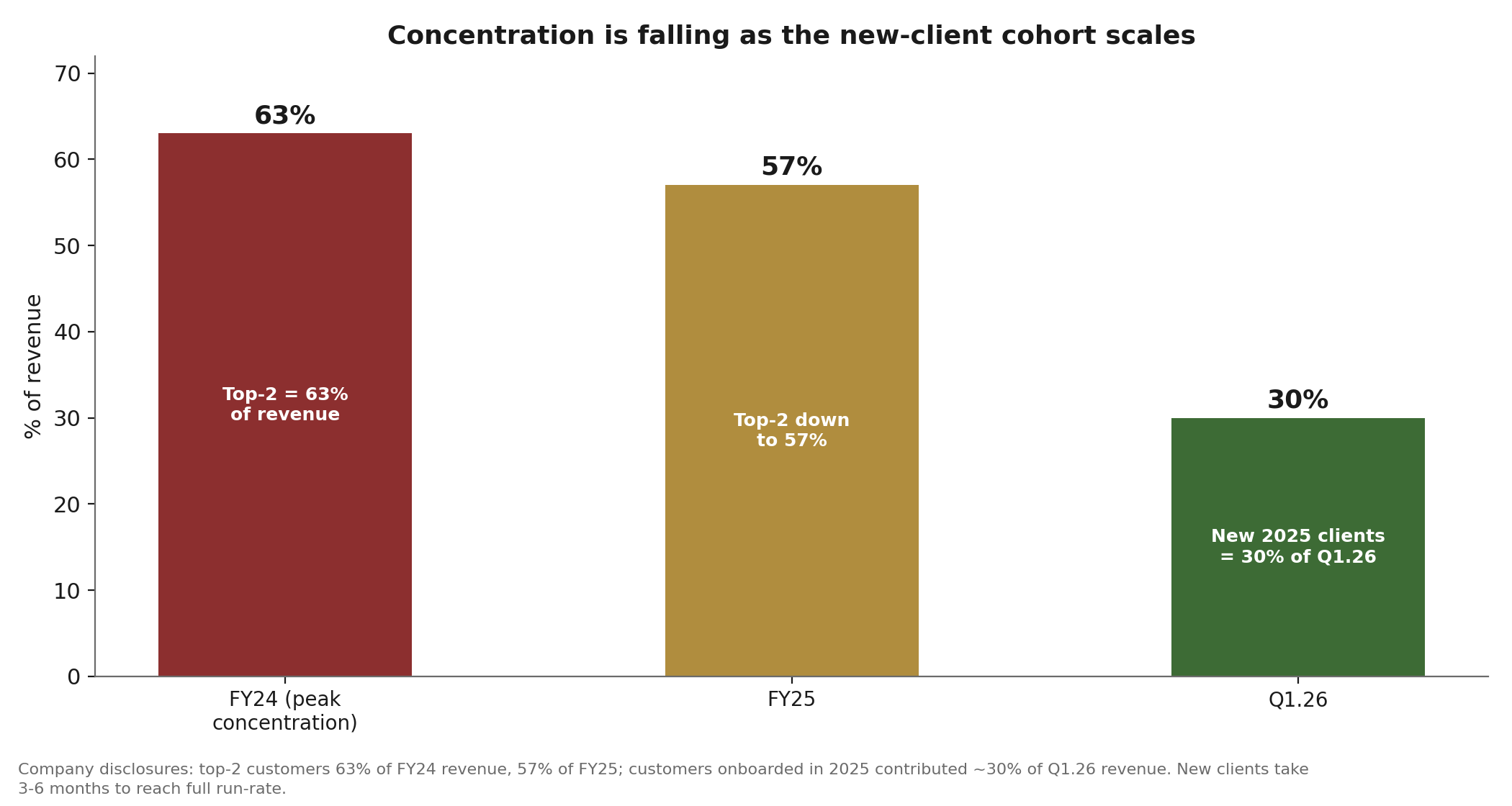
Two of Zoomd’s largest customers asked it to halt marketing while they swapped their MMP — their Mobile Measurement Partner, the third-party attribution software that tells an advertiser which campaigns are actually driving installs and paying users. When a large advertiser changes its MMP, measurement is disrupted during the migration and spend is paused until the new attribution stack is validated. Bohensky has said an MMP swap of this kind has happened twice in Zoomd’s entire history — low probability, high impact when it lands on two top customers at once. Those two were about 63% of revenue at their FY24 peak and 57% in FY25, so pausing both took the top line down hard: Q4.25 revenue fell 50% year on year to C$10.6m, and Q1.26 fell 62% to C$9.7m.
This is a process interruption, not a lost account or a competitive defeat. Bohensky’s framing on the Q3.25 call was that “such transitions are a part of our business, and based on our experience, activity typically scales back up within a few months.” By the FY25 and Q1.26 reports the picture had split: one customer is “showing early signs of realignment,” while visibility with the other “remains limited as the transition continues.” One is coming back and one is uncertain — the kind of ambiguity that creates mispricing, because the market has written off both.
The bear counterpoint deserves stating, because it is fair: in Q1.26 management also cut roughly 20% of the workforce to “align cost structure with current activity levels,” and a company confident in an imminent recovery does not usually cut a fifth of its staff. The generous reading is cost discipline that protects cash while the transition plays out; the skeptical reading is that management expects the reduced run-rate to persist. The thesis does not require resolving that debate — only that the cash floor holds while the upside levers have time to work.
Zoomd has been here before
The most useful thing in Zoomd’s history is that this is the second collapse, not the first — and the audited accounts show what happened last time.
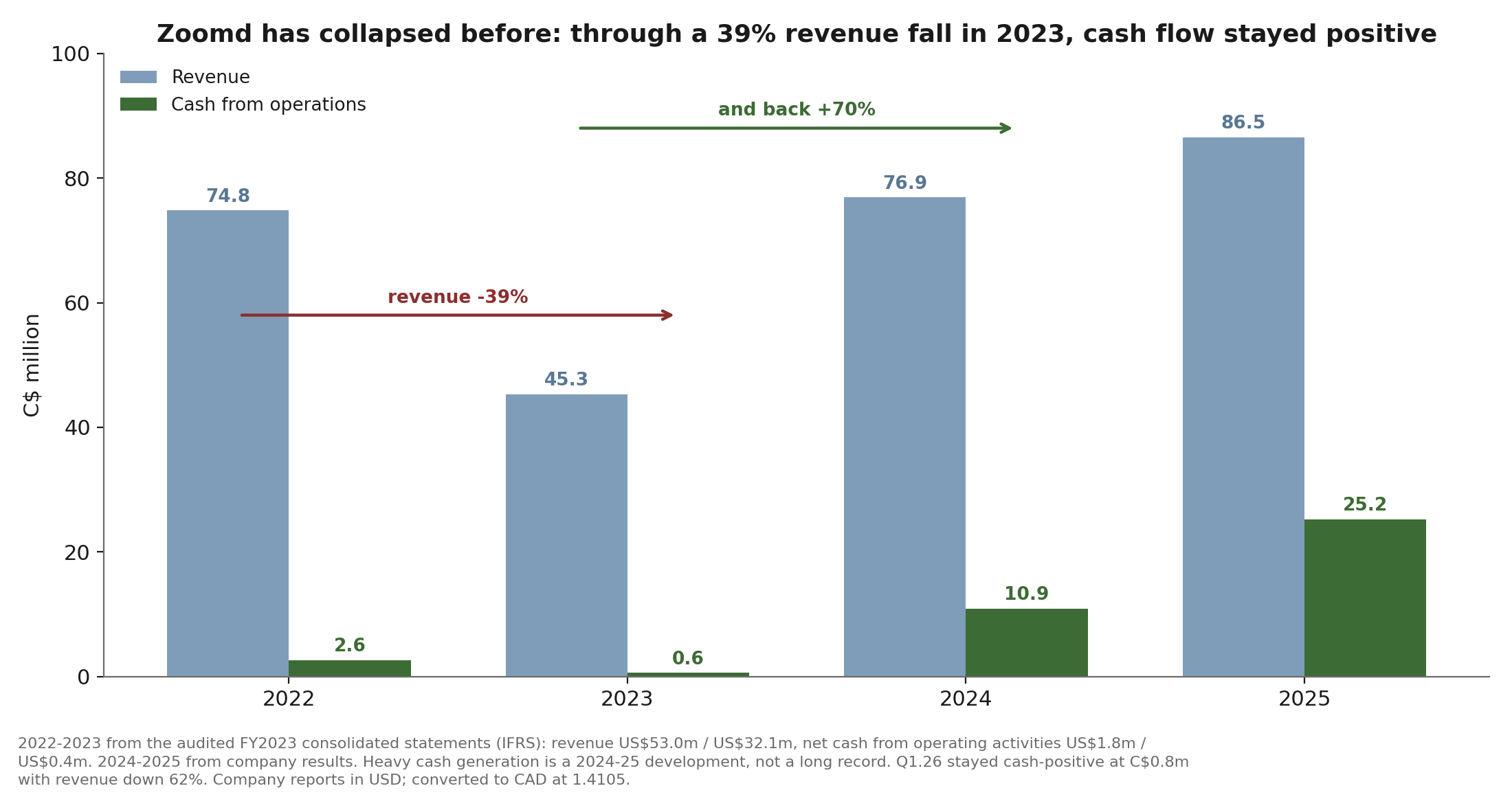
In 2023 revenue fell 39%, from C$74.8m to C$45.3m. Management cut about 40% of the workforce, wrote off C$4.0m of capitalised software as unrecoverable, and the shares fell from C$0.175 to C$0.065. It looked terminal. Two things then happened: the business stayed cash-positive throughout — net cash from operations was C$0.6m in 2023, thin but never negative — and revenue recovered 70% the following year, to C$76.9m.
That is the base rate the market appears to be ignoring. The pattern now rhymes with 2023: a revenue collapse, a workforce cut, a share price down roughly two-thirds. Last time the cost structure absorbed it and the business came back.
The mechanism is the same in both episodes. The bulk of cost of revenue is publisher and traffic-source spend, which contracts directly with revenue; the fixed base is primarily Israeli salaries and a single Herzliya office. That is why Q1.26, with revenue down 62%, still produced positive operating cash flow of C$0.8m — the same thin-but-positive shape as 2023. A business that stays cash-positive at halved revenue does not burn through a C$31.7m cash pile.
One thing the chart does not let me claim, though, and it matters: heavy cash generation is a 2024-25 development, not a long record. Operating cash flow was C$2.6m in 2022 and C$0.6m in 2023 before stepping up to C$10.9m and then C$25.2m. Two strong years is evidence that the model can generate real cash at scale; it is not proof that C$25.2m is a level to underwrite. The floor argument rests on the business staying cash-positive, which it has done in every year on record. The upside argument rests on it getting back toward the 2024-25 range, which is a judgement, not a given.
The asymmetry
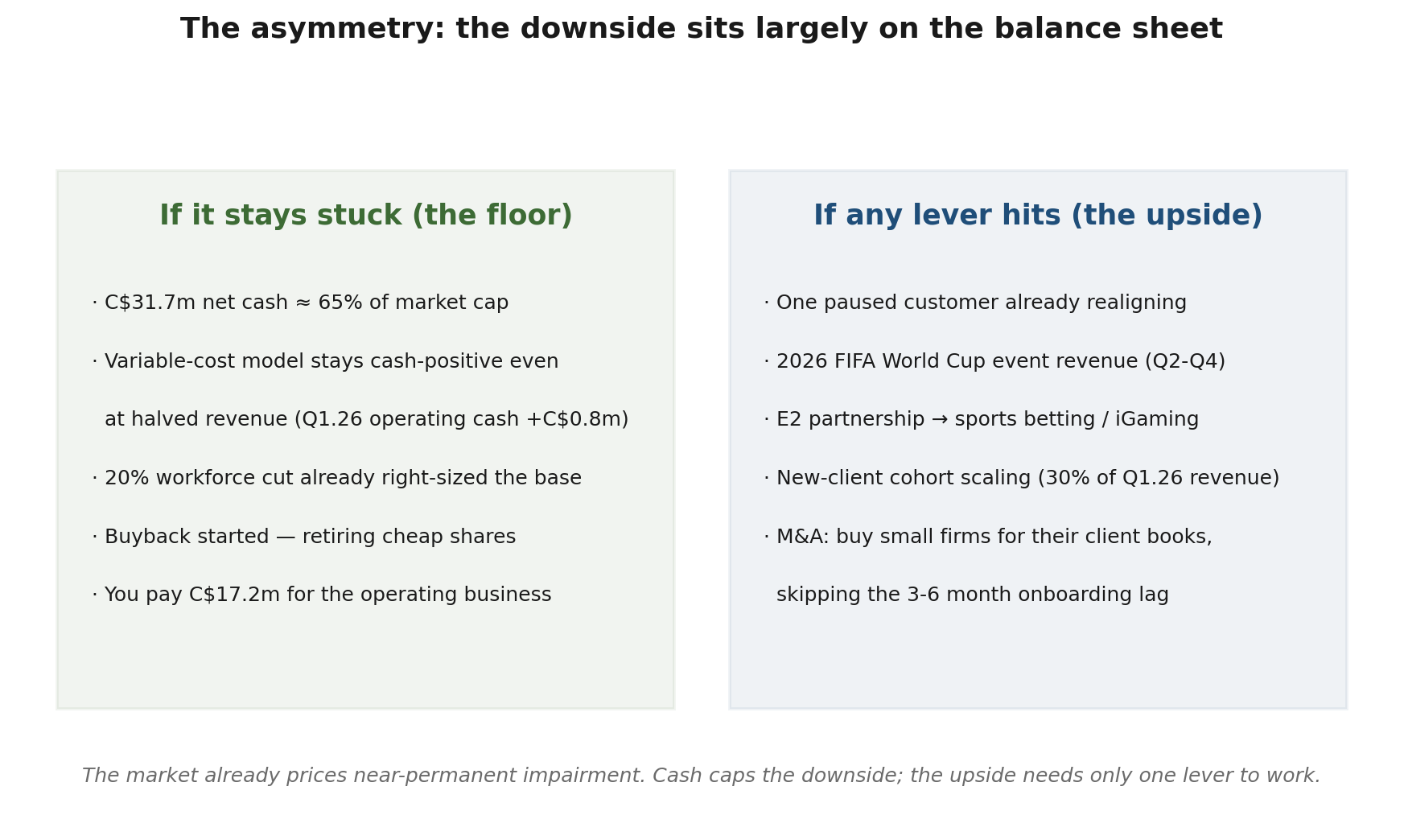
The floor. C$31.7m of net cash is about 65% of the market cap. The variable-cost model stays cash-positive at today’s depressed revenue. The workforce reduction has already right-sized the cost base. Management has started a buyback, retiring stock at these prices. For you to lose a lot of money permanently, Zoomd has to both lose its remaining business and burn its cash — and the cost model plus the balance sheet make the second leg hard.
The upside — not one bet, several independent ones:
-
The recovering customer. One of the two paused customers is already realigning. A return toward its prior run-rate would materially re-rate earnings, because the market values that revenue at close to zero. The second returning is additional upside nobody is paying for.
-
The 2026 FIFA World Cup. Major sporting events drive surges of user-acquisition spend from betting, media and app clients. Zoomd has flagged the World Cup as an event-revenue opportunity concentrated in the back half of the year — a scheduled, known catalyst.
-
The E2 partnership. In 2025 Zoomd partnered with E2, a global player in digital marketing and technology for the sports and betting industry — a route into iGaming and sports-betting user acquisition at exactly the moment a World Cup is coming.
-
The scaling new-client cohort. Customers onboarded during 2025 contributed roughly 30% of Q1.26 revenue, and top-2 concentration fell from 63% (FY24) to 57% (FY25). New clients take 3-6 months to reach full run-rate, so the cohort already onboarded is revenue that has not fully landed yet.
- Tuck-in M&A for the customer books. Management has named selective M&A as a 2026 capital-allocation priority, and Bohensky has described buying small marketing firms partly for their existing client relationships — acquiring customers while skipping the 3-6 month organic onboarding lag. With C$31.7m of cash and a sector full of sub-scale players, Zoomd can buy revenue rather than build it slowly.
Because the enterprise value is only C$17.2m, a recovery toward even a fraction of prior profitability implies a re-rating that is a multiple of today’s EV. You are not underwriting a single catalyst; you are underwriting several, with a cash floor underneath.
Valuation
At a C$48.9m market cap with C$31.7m of net cash, the market prices the entire operating business at C$17.2m — less than one times the C$25.2m of operating cash flow it produced in 2025. That is a valuation appropriate for a business believed to be permanently and severely impaired. The evidence points elsewhere: it is cash-positive at halved revenue, one large customer is already returning, concentration is falling, and there are scheduled upside catalysts. If Zoomd stabilizes anywhere near a normalized level of profitability, the re-rating from here, on top of the cash, is a large multiple of the current enterprise value.
One caveat on the cash-flow figure: 2025 operating cash flow of C$25.2m ran well ahead of the prior year and benefited from working-capital timing in a business whose receivables swing with campaign volume. Treat it as evidence of a genuinely cash-generative model, not as a run-rate.
There is also an unrecognised asset here. At December 2023 Zoomd carried roughly US$20m of tax losses forward, with no deferred tax asset recognised against them because taxable income was not then in sight. Those losses shelter a meaningful slice of the profits earned since. It is not a reason to own the stock, but it does mean reported profits convert to cash better than a 23% Israeli corporate rate would suggest.
Risks, honestly weighted
- Customer concentration is the core risk, and it just bit. Two customers were 57% of FY25 revenue; the top ten were ~86%. The second paused customer may not fully return.
- The 20% headcount cut cuts both ways. It protects cash, but it may signal that management expects the reduced run-rate to persist. Take it as evidence, not reassurance.
- The recovery is genuinely uncertain. Management’s own language is “early signs of realignment” for one customer and “visibility remains limited” for the other. Some analysts who covered the name took losses and exited after Q1.26.
- The new-client cohort has to keep scaling. 30% of Q1.26 revenue from 2025 cohorts is encouraging, but it has to grow enough to offset the lost concentration, and new clients can churn.
- The cash-generation record is short. Two strong years (2024-25) follow two thin ones (C$2.6m and C$0.6m of operating cash flow in 2022 and 2023). The business has always been cash-positive, but the scale of recent cash generation has not yet been tested across a full cycle.
- MarTech is competitive and platform-dependent. Privacy changes cut both ways — they create the complexity Zoomd sells into, but they also constrain the whole ecosystem’s measurability.
- Operations are concentrated in Israel. Staff, the single office and the functional cost base sit in Herzliya, which brings both geopolitical exposure — the company flagged the October 2023 attack and the subsequent conflict in its accounts — and currency mismatch, since costs are largely in shekels against USD revenue.
- M&A execution risk. Buying sub-scale firms for their client books is sensible in theory, but retaining acquired customers is not guaranteed, and capital spent on a bad deal is gone.
- Microcap illiquidity and FX. Thin TSXV trading, a CAD quote on a USD-reporting business, and a small float mean this is a long-term ownership stake, not a trade. The CAD figures here move with the exchange rate as well as with the business.
What has to be true for this to lose money permanently
Not every catalyst needs to fail at once. An insufficient recovery, a value-destructive acquisition or persistent margin deterioration can reduce per-share value. Cash belongs to the company: it funds working capital, obligations and investment, and is not a guaranteed distribution to shareholders. The test is preservation of cash per share and a return to sustainable profitability, rather than positive operating cash flow in a single quarter.
Catalysts
- The recovering customer returning toward prior run-rate — the cleanest re-rating trigger, and the market pays nothing for it.
- 2026 FIFA World Cup event revenue landing in Q2-Q4 2026.
- The E2 partnership converting into sports-betting / iGaming revenue.
- The 2025 new-client cohort scaling past 30% of revenue and further cutting concentration.
- Accretive tuck-in M&A using the cash to buy customer books and skip the onboarding lag.
- The buyback retiring shares at a price where most of the market cap is cash.
- Simple stabilization: two or three quarters showing the revenue base has found a floor would by itself challenge the market’s pricing.
A note on sizing: Zoomd is a microcap with heavy customer concentration and a genuinely uncertain recovery. Position sizing should reflect that.